


I cannot tell you how obsessed I was with this game as a nine-year-old. I loved it so much; I thought it was the coolest, best-designed, most immersive world; I lived for wandering around Rosemond Valley, pretending I was a journalist on my way to interview someone in my quirky town’s hair salon. (And it had free movement! Midnight in Salem could never.)
That said, despite my passion for pretending I was solving mysteries, I was completely incapable of finishing this game on my own. I swear, the hours I spent trying to beat it, until I just ragequit in frustration and moved on to downloading emo hair for my Sims in The Sims 2.
Anyway, since this game has haunted me for just under 20 years, I thought I’d take a crack at it again and actually try to finish it. And I did! With the help of a walkthrough, but still.
As I’ve mentioned before on this blog, I was a horse girl as a kid, and I got this game in a set called Let’s Ride: The Rosemond Hill Collection. Two of the games were horse-related — one was a straightforward show-jumping competition game, fittingly called Competitions at Rosemond Hill; the other was…also a show-jumping game, but loosely built around a storyline about saving the family farm or some shit, called The Legacy of Rosemond Hill. (I also could not beat the Legacy game for the life of me. I considered trying to finish it for a recap as well, but it really doesn’t have enough of a story to sustain even half a post. It is a game for the horse girls only.)
The third game was this one, The Diamond Mystery of Rosemond Valley. It’s kind of related to the horse games, I guess, in that they were made by the same studio, the title is similar, and the games feature a girl named Annie. Other than that, though, they have nothing in common. I don’t know if the studio just couldn’t be fucked to come up with another name for their fictional town. (They also made another game called Drömjobbet i Rosemond Valley, which I don’t think ever got an English release. It’s apparently about managing a mall, even though this game is also set in Rosemond Valley and there is no mall in sight. The Rosemond Cinematic Universe does not have the greatest continuity.)
Anyway, I lost those CD-ROMs sometime during Bush Jr.’s second term, but I found the game online. It took a lot of trial-and-error to play it, so if anyone happens to stumble upon this post while looking for ways to make this game run: you just have to suck it up and install a virtual machine that runs Windows XP. I tried to run it on Windows 10 with every possible combination of compatibility mode, color settings, and resolution; I also tried running it through several emulators, and only straight-up installing Windows XP worked. Hope that helps.
We open with a cutscene, which I cannot show you here because Irfanview couldn’t hook into the game while it was playing these videos for some reason. Some dude in a trenchcoat sneaks into a museum during a ~dark and stormy~ night. He approaches a display case, smashes it open, then speeds off into the night. Mysterious!
We then cut to our protagonist, Emma. She’s in a diner, telling her sister Annie about her super-cool new job at the local newspaper. In Legacy of Rosemond Hill, Annie is the protagonist and is on a mission to become the greatest show jumper ever. She occasionally gets calls from her sister during the “story” portion of the game, although the sister is never named. In this game, though, Annie is a waitress at the diner who occasionally dispenses plot information and stuff we can put in our inventory. Rough life.

Emma gushes that she’s always wanted to be a reporter, and now she finally has her chance! Annie sighs that she wishes she could follow her dreams and not be stuck serving food for minimum wage. Maybe she could even be, like, a show-jumping champion one day! Emma’s like, “No one cares about your dreams, this is my game right now.”

And so, we cut to our first day on the job. We meet with our boss, who introduces himself as Bob. “Emma,” Emma deadpans, staring straight ahead. Yeah, the voice acting and animation in this game is…lacking, although in total fairness, it’s fine for a children’s game in 2002. Bob gives us the rundown of our equipment and home base: we have a beeper(!) and a film camera(!!!), and there’s a tape recorder(!!!!!) and a computer at our desk so we can do research. We have five suspects other coworkers: Bob, the editor-in-chief; Carla, the managing editor; Tom, the photographer; and Malcolm and Lucy, who are regular reporters. Our job is supposedly to act as support for everyone by doing research, taking extra photos, etc. Of course, we are not going to be doing any of this, because we’re going to stumble on a mystery and start investigating it instead of doing our actual job.

We can access our inventory by pressing the “I” key. Right now, all we have are a notebook and a map (which we can access from here, or by pressing “N” and “M”, respectively). This game actually does not have a toolbar or any other kind of click interface; instead, you use your keyboard to move around and perform actions. This takes some getting used to but is mostly fine once you get the hang of it. The only thing that really fucked me up is that you press “U” to use or pick up objects…and also to talk to people. I spent an embarrassing amount of time pressing “Enter” every time I got close another human being.
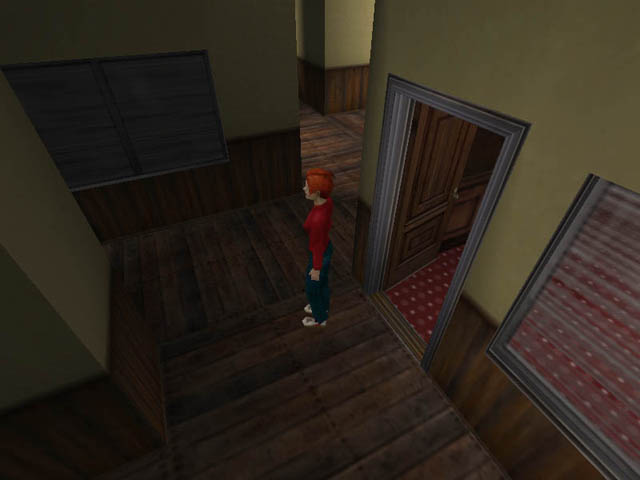
With that, we leave Bob. The camera and movement in this game is, uh…

I’d call it “non-instinctive”, on a good day. Basically, pressing the up key will cause Emma to walk forward, wherever “forward” is from her perspective. So in the screencap above, I’m pressing the up key, but Emma’s walking straight towards the camera (which is “down” from the player’s perspective). The camera sometimes swings around and faces a new direction when you turn corners or enter a new room, so it can take a moment to remember which way you’re going. As with the keyboard shortcuts, you get the hang of it after a while, but still — mildly annoying.
(This game came out in 2002, so if you want to do a Nancy Drew quality comparison, it would have been peers with The Final Scene and Ghost Dogs of Moon Lake.)

Here’s me nearly walking into a wall, which I did with frequency while playing this game.

So we go into the main office, which is where Malcolm and Lucy sit. Let’s approach Lucy first. She’s meant to be painfully shy, which the designers have expressed by making her spend every conversation staring at the floor and speaking just above a whisper. Ooh, do you think she’s hiding some kind of dark, mystery-relevant secret? She mentions that she’s glad not to be the only girl around here, and Emma’s like, “What about Carla?” Lucy not at all subtly says that Carla’s not a girl, she’s “an old wi…I mean, woman.” Smooth. We ask why Lucy’s hanging around the photocopier, and Lucy bitters that she’s supposed to be a reporter, but she ends up just doing a bunch of boring menial jobs instead. So…Bob’s paying us to do the same thing that Lucy’s already doing? This newspaper office isn’t very good at budgeting.
Lucy bitters some more about the other staff reporter, Malcolm. She says he gets to do all the fun stories because Carla plays favorites, and she likes Malcolm better because he used to work for a big paper in New York*. He got to interview the President when he came to town, while Lucy got stuck doing a story about the vote for which color the town parking meters should be. (“42% voted for red meters and 58% voted for blue.” Fascinating stuff.)
*This game was actually made by a Swedish studio, and I think originally released in Swedish? I’ve never found a Swedish version of it — although it’s pretty easy to find in Finnish — but the credits list someone as working on “Localization”, so I’m assuming it was translated and Malcolm was originally from Stockholm or something.
(Also, the president at the time this game came out was George W. Bush. LMAO.)
We can also ask where Tom is, and Lucy says that he’s in the darkroom, but he’ll be pissed if we interrupt him while he’s working.

Let’s move on to Malcolm. Dig the textures on that computer behind him! Anyway, we introduce ourselves and Malcolm immediately smarms, “A sweet name for a sweet girl.” Ick. The 2000s were not good years for harassment in the workplace. We chat a bit about the paper and bring up that Lucy doesn’t seem to get to cover anything interesting. Malcolm shrugs that Lucy never speaks up, so it’s hard to tell what she wants. We also bring up that this paper is weirdly interested in fishing — Lucy told us that Carla has a pet piranha, and Bob makes everyone do a bunch of stories about angling. Malcolm blows off our observation and just says, “What about you? What are you interested in?” “Becoming a good reporter,” Emma snips. Malcolm offers to teach us some of his tricks: for example, how to make people lower the guard so that they’ll talk to us. Emma clutches her pearls at the idea that journalists might be manipulative.
We can also ask Malcolm why he left the big city to work here in a generic small town that conveniently looks suitably European or North American. Malcolm says he simply got tired of the big city stress. He’s only been here for a month. Wow, and he’s gotten to interview Dubya? Carla really is playing favorites. Sue for sexism, Lucy!

Our desk is next to Malcolm’s. We go through our drawers and find our camera (“There’s already film in it! Great!”) and our beeper. “I feel really professional,” Emma says, pocketing the beeper. HEE!
We can also use our computer to look stuff up in “the database”, although we only really need to use it once or twice. If you use the computer now, Emma will do a search for angling and find out that the paper has published over 3,000 stories just on fishing. I bet after Bob gets divorced 15 years after this game, he’s going to be a fish guy on Tinder.
We can also explore the rest of the room. There’s a thermostat in the corner, which Emma will refuse to use now, which is how we know it will be important later. There’s also an empty desk, which has a tape player lying on it. “Isn’t it about time to get a CD player?” Emma snarks. Yeah! CD players are the future!
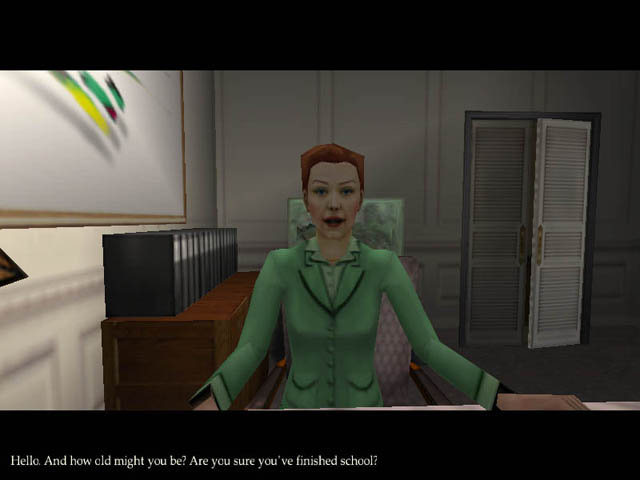
Let’s meet Carla. Her office is down the hall, to the right of the main newspaper room. She’s all middle-aged and cranky and hates young whippersnappers with their newfangled ideas. She tells us to come to her if we have any questions, but if you do, she’ll just blow you off and say that she’s busy. We also have a few conversation options to make suggestions for the paper, but Carla will just shut down all of our ideas. We bring up the paper’s obsession with fishing and note that Carla must like fish too, seeing as she has a pet piranha (named Pierre. Heh). “Yes, they can eat a person in less than a minute!” Carla chirps. Thanks, Carla. Before we go, she adds that we aren’t allowed to come into her office when she’s not here. But Carla, then how am I going to snoop through your stuff?

Finally, we can go visit Tom. We knock on the door and he yells at us to go away. But Tom! I’m your new coworker and I’m trying to be friendly!
“CLOSE THE DOOR YOU STUPID PERSON!!!!!” Ouch! Harsh words, almost as hurtful as “You best stroll on out, less you want to roll on out.”

Also I didn’t even open the door? Chill out, Tom.

Let’s go back to Bob and see if he has a job for us. He tells us that a movie star named Kit Grace is originally from Rosemond Valley, and she’s coming back for the first time in twenty years. Naturally, Malcolm will be doing the story, but we can support him by getting some background interviews for his article. Bob tasks us with interviewing one of Kit Grace’s childhood friends, a woman named Debbie. She works in a hair salon in town, to which Emma derps, “A hair salon. Is she a hairdresser?” Somehow, Bob doesn’t fire us on the spot after that question.

Let’s see what Malcolm has to say about this. We tell him we’ve been assigned to help him on the Kit Grace story and he’s like, “Cool.” We ask if he wants us to do anything in particular, and he’s like, “What did Bob tell you to do?” We tell him about Debbie and he’s like, “Okay, go do that then.” Way to take charge of your story, Malcolm.
Before we leave, let’s see how Lucy is doing. We ask if she needs any help with her filing or copying or whatever the hell she’s up to, and she says no — “But thanks for asking anyway. Nobody ever does.” Mmm, tastes like resentment.
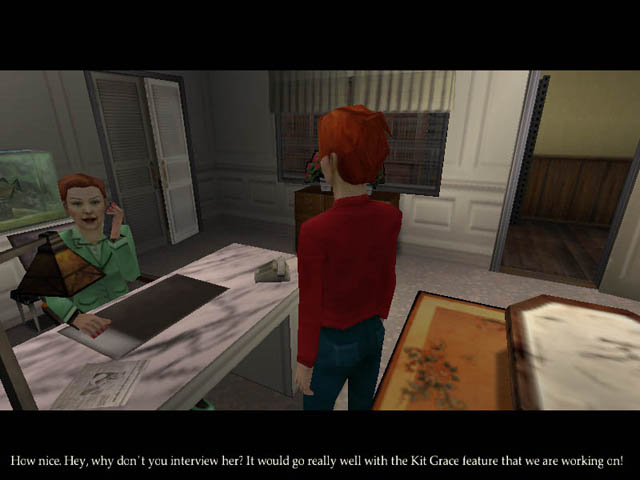
We pop into the office to tell Carla that we’re working on the Kit Grace story, and we’re off to interview her childhood friend Debbie. “How nice. Hey, why don’t you interview her? It would go really well with the Kit Grace feature that we’re working on!” Okay, so Carla’s not even pretending to care about us anymore. She tells us that she’s busy wrangling the rest of her workers to meet their deadlines and goes back to talking on the phone — “We have a deadline to meet, I don’t care about your working conditions! You should be printing a newspaper, not running around with stupid posters and going on strikes!” HEE.
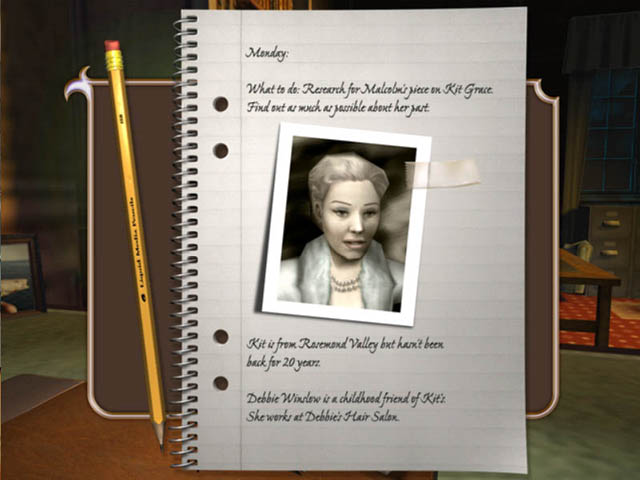
Much like a Nancy Drew game, the notebook in this game will loosely recap where we are in the game, and hint at what we need to do next. We can fuck around the office some more and try to Google Kit Grace, but all we’ll find out is that there’s nothing on her life before Hollywood. Therefore, we must interview Debbie to get any information on her.

Debbie’s salon is in “Old Town”, which is a different part of the map than where the newspaper office is. We can use the map to teleport there, or we can take a leisurely stroll and stop to talk to these disaffected youths. The only conversation option is to ask for directions to Debbie’s salon, but they don’t know where it is.
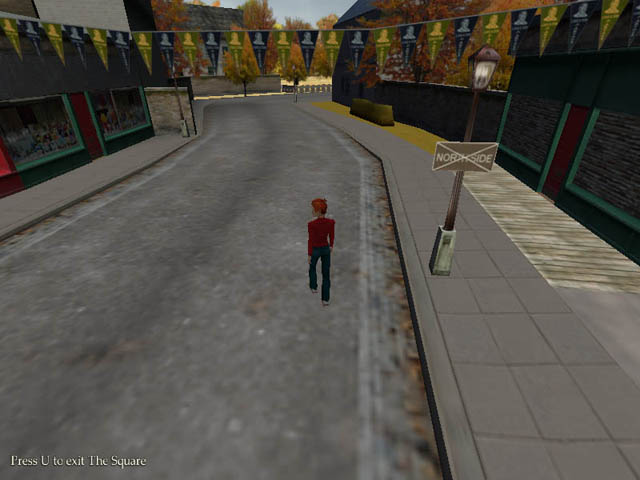

So we stroll out out of “The Square”, which is where the newspaper building is, and into Old Town.
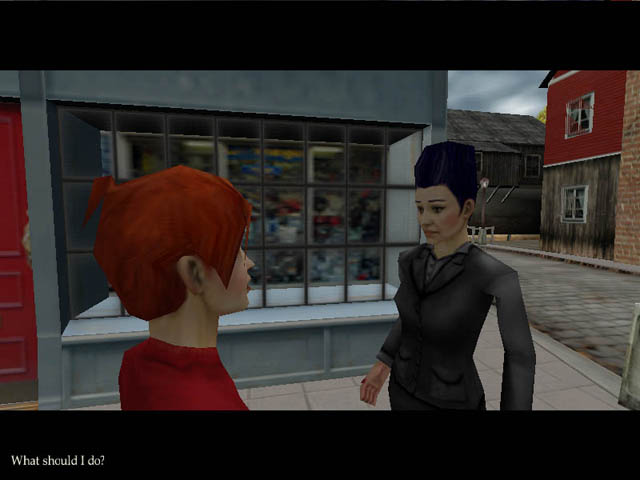
We immediately run into this lady and ask her where Debbie’s salon is. The woman bursts into tears and tells us not to go there. I mean, whatever Debbie does, it can’t be worse than that tiny spike of hair sticking out of the back of Emma’s head.
Anyway, we don’t really need to ask for directions at all, because Debbie’s salon is literally straight ahead of us, at the end of the street.
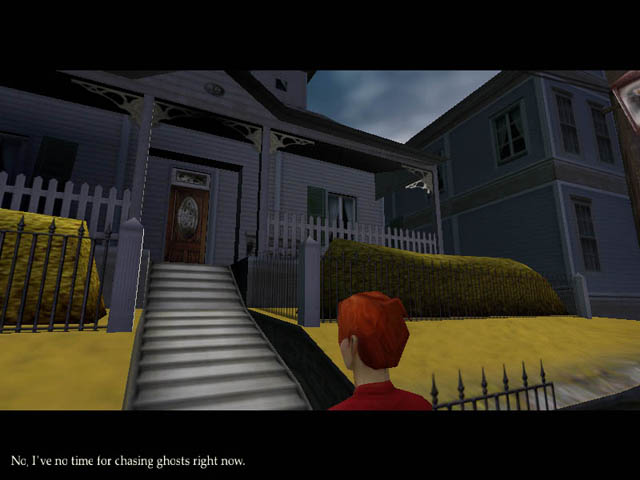
We can also take a look at this house at the side of the street, but Emma will say, “I’ve no time for chasing ghosts right now.” This line makes zero sense at this point in the game.

Alright, let’s go meet Debbie. She tells us that Kit Grace’s real name is Sue Holmes; her stage name comes from her middle name, Grace, and her husband’s nickname for her, Kitten. Emma remarks that she didn’t know that Kit Grace was married. Debbie doesn’t give us any details on that; she merely remarks that marriages in Hollywood never last. Biting commentary!
Debbie reveals to us that Kit used to be unattractive and unpopular back in school, but she was always a deeply annoying theater kid who was convinced she was going to blow this popsicle stand for somewhere better. After she got her big break, she left town and never came back, and doesn’t even call her mother. Emma jumps at the idea of talking to Kit’s mother, and Debbie says that Mrs. Holmes lives in the big house that we passed earlier. I guess we have time to chase ghosts now, Emma.
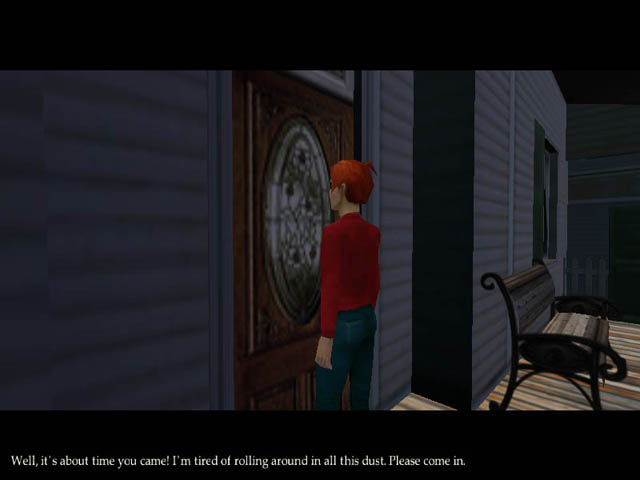
So we go back to the house and try to get inside. If we say we’re a journalist, Mrs. Holmes will yell through the door that she hates journalists and we should fuck off. We instead want to pretend to be her housekeeper.

We go inside the house and meet Mrs. Holmes. We immediately try to butter her up by saying that she looks just like Kit Grace, and Mrs. Holmes immediately tells us that Kit is her daughter. She won’t talk about her any further until you start dusting; once we’ve puttered around a bit, we can start asking more questions. Mrs. Holmes tells us that Kit left town after her husband disappeared. We ask if he might’ve been having an affair, which feels kind of spicy for a children’s mystery game. Nancy Drew would never suggest such a thing! Anyway, Mrs. Holmes doesn’t think he was — he just left one day and never came back, and Kit was devastated. “Everybody disappears,” Mrs. Holmes says sadly. “People and socks.” I feel that.
We then take a brief detour into discussing Debbie, and Mrs. Holmes says that she needs to make an appointment with her. “My hair looks disgraceful!” Heh. The writing and voice acting in this game is kind of awkward, but there’s a quirkiness to the characters that feels very genuine and charming.

We can walk around the room and pick up the rest of our plot points: we see a poster advertising a…play? Movie? Circus show? starring “Georgina Holmes.” Mrs. Holmes says that’s her and tells us to take the poster, which we will be using later. Then we ask if she wants us to clean the attic, and Mrs. Holmes says that she’d like us to, but there’s no light up there. That ends our visit for today, and as payment, she gives us her museum membership card. I’m glad to see this game understands the key features of a 2000s children’s mystery game: a redheaded protagonist and refusing to compensate us monetarily for our labor.
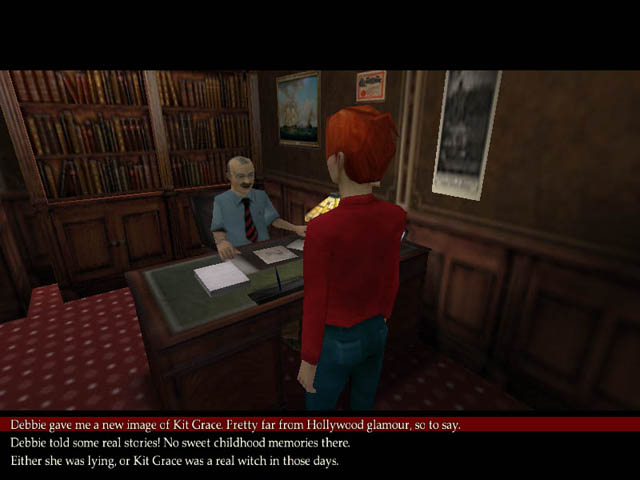
We have to stop off in Debbie’s salon and book Mrs. Holmes’s appointment for her. After that, we go back to the office and check in with Bob. We tell him about meeting with Debbie and how Kit Grace actually has a secret backstory that nobody else know about until now. Bob is pleased that we got some meaty gossip and he compliments our journalistic skills, but then he remarks that we won’t print it. He’s worried that Kit Grace will lawyer up if we spill the sordid details about her marriage to everyone, and she’s the most famous person to ever come out of Rosemond Valley, so it would really ruin the town’s image if we were to print this stuff. “But I thought the readers wanted the truth?” Emma asks. “Sometimes the truth is not the best idea,” Bob says. “Like telling people that there are WMDs in Iraq so we can invade,” he doesn’t add.
After that crushing lesson in journalistic ethics, we don’t have anything else to talk to Bob about, so let’s go see if we can meet Tom now.

Dreamy. He introduces himself as the resident photographer, which we already knew. We ask if he can use his darkroom sometime, and he’s like, “Do you know how to develop film?” Emma’s like, “Yes” and he’s like, “No, you can’t use my darkroom.” What was the point of that question, then? Anyway, he proceeds to tells us about how he hates working for the Rosemond Valley Post and he thinks his talents are being wasted here. He plans to bail on this town as soon as he gets his big break. Emma asks where he’d like to go, and Tom smarms about how he shot a model pageant in Hawaii recently, and that was pretty sweet. “Lots of babes in bikinis,” he sleazes. Why does every man in this game talk like Joey Tribbiani?
We ask some more about the modeling pageant, and Tom slimes some more about how models aren’t that good looking in real life, he makes them look good with his camera, and they come flocking to him. “They’re nothing without a good photographer,” he says. Ew. He brags to us some more that he knows tons of famous people; in fact, he was just shooting Kit Grace at the airport. Er…based on that photo in Emma’s notebook, is Kit Grace really that big of a deal? I can believe she’s a famous, well-established actress, but she’s like sixty years old. It’s kind of weird that the game is acting like she’s the newest and hottest thing and is getting stalked by paparazzi everywhere.
We press him some more about all his celebrity friends, and he awkwardly redirects the conversation back to his trip to Hawaii. Weirdly, he says Bob and Carla showed up a couple of days later. At…the model pageant? At the hotel? The writing doesn’t really make it clear how they ran into each other. Anyway, Tom speculates that they’re having an affair, because they were acting really cagey and weird and pretended not to see Tom. “I can’t imagine a more ill-matched couple,” Emma remarks, as though we didn’t just meet the two of them like three hours ago. Also, all we know about them is that they both love fish, so like…I could imagine more ill-matched couples. Like Kyler Mallory and any of the men who were inexplicably interested in her.
Tom hits on us some more about how sometimes opposites attract, like, say, a sleazy fashion photographer and an uptight sanctimonious intern. “Nothing wrong with a bit of a fling in the office,” he says. “I think there is. It’s WRONG. VERY WRONG,” Emma says. Hee!

Our final dialogue is us asking him, one more time, if we can use the darkroom. Tom says no one uses the darkroom except him and kicks us out. That seems weird. If he’s busy, can no one else have photos for their stories?
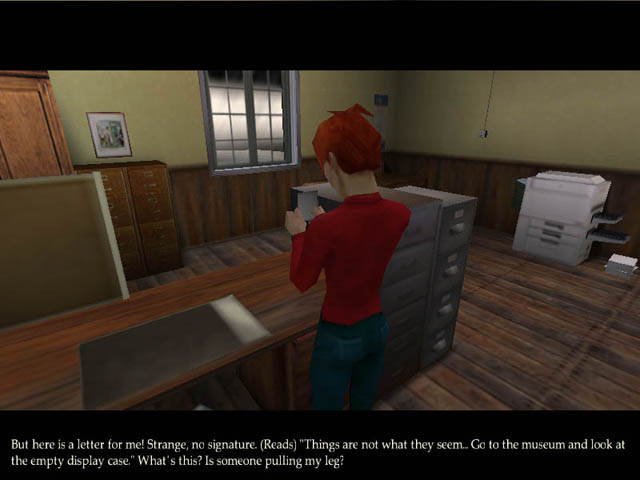
When we go over to our desk again, the plot has arrived: someone has left a note for Emma announcing that ~things are not what they seem~, and we should go to the museum and look at the empty display case to find out more. Nobody else is around except for Tom, and he denies leaving the note for us. Welp, I guess there’s nothing else to do except go the museum and get our mystery rolling.
Up next: We invade our coworkers’ privacy and apparently ruin our hair.


Leave a Reply