
Oh, look, something that’s been in my drafts for nearly three years! Since it’s spooky season, I figured it was time to finally post it.
Anyway, I loved the Midnighters series by Scott Westerfeld as a lil grade schooler — all the way up into high school, even. It occurs to me that I haven’t actually read them in like ten years. When I went to college, I lent them to my brother and he never put them back into my room, and I completely forgot about them. I randomly had the urge to reread them the other day, and then I got hit by a barrage of memories, like posting on Scott Westerfeld’s blog and forums, and how everyone used to call each other “Name-la” or “Name-wa”, and how we unironically described things as “fawesome.” God, the 2000s were so embarrassing for me.
My own personal cringey memories aside, though, Scott Westerfeld’s books make me nostalgic for this era of YA. Twilight and The Hunger Games came out around this time, but they hadn’t spawned quite so many imitators yet, and there were a bunch of other books I loved being published, like the Percy Jackson series, the Gemma Doyle trilogy, a bunch of Meg Cabot books, etc. I won’t pretend it was a Golden Age — YA has always been full of varying quality (Tithe and Boneshaker both sucked, FIGHT ME) — but I was actually a teenager during this time, so it holds a special place in my heart.
This has always been my favorite of Scott Westerfeld’s series, even though it’s the least known. It was his first real YA series, and frankly, that shows. I can fully admit that the potential in these books isn’t as realized as in Uglies or Leviathan, and those series are objectively better for that reason. But I love the concept of Midnighters and the characters so much, that overrides all its flaws.
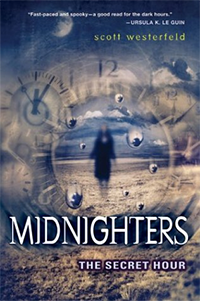
The cover above is the one I have. The books underwent a makeover afterward, to YA-ify the covers, but frankly they are kind of jank. This is their third and current iteration, I believe:

That’s supposed to be our main character, Jessica (the 2nd edition used this same photo, but with Jessica’s midnighter symbol ‘shopped over her eye). I guess it’s okay — I don’t love any of the models they used for the midnighters, if only because they look so different from my imagination, and it seems like each edition of the covers gets farther and farther away from being related to the book’s contents. I infinitely prefer the original, which is a creepy, abstract representation of one of the scenes from the book, but even the 2nd version has the midnighter symbol on the cover at least. This one’s just like, “Here’s a photo of a white girl. It’s about an hour that’s like, secret, I guess.” I also like how they didn’t even try to make her look like a redhead.
Getting down to it: The back of the book informs us that weird things happen in Bixby, Oklahoma at night, and everything changes when Jessica Day moves to town. So let’s not start off with Jessica, but with one of our other protagonists, Rex. It’s the start of a new school year at Bixby High. Rex walks in all bitter, because he’s a mall goth and has spent the last ten years getting mercilessly bullied by all the prepz. However, the narration tells us, these days they mostly leave him alone, and he keeps to himself, because “the daylight world meant so little to him now.” OOOOH.
Then Rex sees the new girl. And we haven’t even left the first page! These books move really fast. With his glasses on (because of course he wears glasses), she’s out of focus, but when Rex looks at her without them, he can see her perfectly clearly. He gets all twitterpated by her plot-important aura and tries to follow her, but that attracts the attention of one “Timmy Hudson”, who starts shoving Rex around. Timmy knocks Rex to the ground and sends his glasses flying.
A lot of preps stare at him. Rex does not put his middle finger up at them.
But then! The new girl gives Rex’s glasses back, and Rex notes once again that he can see her clearly. She has red hair and green eyes, that combination that exists in 0.2% of people in real life but 80% of protagonists in fiction. Rex and the new girl chat a bit — she’s nice, if disoriented — and Rex is all happy that they’ve found “another one.” Rex is DJ Khaled.
After a bunch of classes that we don’t get to read about, Rex goes to lunch and meets up with his two friends, Melissa and Desdemona (nicknamed Dess). The character descriptions in these books are really lacking, but we do know that the three of them wear all black, sunglasses, and lots of steel jewelry; Rex and Dess dye their hair black and Melissa is always wearing headphones and blasting metal music. Stylin’. We get some vague hints about Melissa’s powers, too: Melissa didn’t like crowds; any sizable number of regular people drove her crazy[…]Melissa felt the change between her friends and looked up blankly. Listening, but not with her ears.
Melissa also constantly wears gloves and tries to stay away as far from other people as possible because she’s extremely touch-averse. I bet she’s thriving in this pandemic.
Rex and Melissa are juniors; Dess is a sophomore. Rex exposits that the new girl is named Jessica Day, and she’s also a sophomore. As new kids are a novelty in their small town, everyone wants to be her friend, and the goth outcasts are forced to watch her from afar. Dess snarks that Jessica is right in the middle of “the daylight crowd.” Ugh, preps. “She’s exactly the same as the other hundred and eighty-seven people in here,” Dess says. Don’t cut yourself on all that edge, Dess. Rex tells them that Jessica is one of them (one of us! one of us!), and Dess agrees to stalk her on Rex’s behalf when he’s in class.
By the way, Jessica’s name was originally meant to be Gillian Flood, but Scott Westerfeld was overruled by various people behind the scenes. The last name “Day” is totally uninspired, but I actually really love “Jessica” as a first name. It’s one of the most common names for girls, but it rose to popularity relatively recently, so it doesn’t quite have a classic ring to it yet. It does the work of implying that she’s basic and daylight, but in a much subtler way than her last name. (No offense to any Jessicas reading this. I mean, my name — Emily — would have worked for the exact same purpose. I think “Emily” was even more common than “Jessica” for at least a few years in the ’90s.)
The next chapter is from Jessica’s point of view. She trudges into her last class of the day, advanced trig, and inner monologues that she hates being the new kid. She hopes that the teacher won’t make her give an introductory spiel. Apparently she’s been having to give one all day, and then she reproduces it for us so we can get her backstory out of the way: she’s from Chicago; her family moved to Bixby because her mom got a job designing airplanes. Her dad is unemployed*, and she has a bratty younger sister named Beth. Oh, and Jessica thinks the Bixby water tastes funny. Heh.
* It’s implied that her dad lost his job when the dot-com bubble burst. Man, these books are ancient.
Dess rocks into trig class and makes a beeline for Jessica. Bizarrely, they don’t recognize each other at all. In such a small school, you’d think they’d share at least a few more classes. Dess quickly starts correcting all the answers in the textbook, showing off her mad math skillz, while Jessica quietly panics about falling behind in class. Heh. Dess and Jessica are pretty mutually awkward — Jess tries to make small talk while Dess throws her weird, cryptic curveballs about how Bixby is mysterious and how some people find that the funny water gives them weird dreams. Jessica’s like, “O…kay.” She’s weirded out by Dess’s non-sequiturs and the way Dess stares at her, but at the same time is mildly transfixed by her. I ship it.
That night, Jessica experiences a WEIRD DREAM. Right after Dess told her she would! Could this mean something? She wakes up to see that the whole world is blue, and the sound of the rain has stopped outside. She goes outside and sees a bunch of “diamonds” suspended in the air, which turn out to be raindrops, which are frozen because time has stopped (not that Jessica realizes that yet). Jessica is confused, but quickly decides that she’s just having an awesome dream and plays around in the rain for a while. The next day, she’s all happy…until she realizes her clothes from last night are wet. ~*~OH SNAP~*~
Now it’s Friday, and the midnighters head off to high school. Melissa picks Rex up, and we find out her power is the ability to read minds. It is not fun for her, because she can’t turn down any of the voices in her head — think Buffy in the middle of “Earshot.” She wears headphones and constantly plays heavy metal to try and drown them out. As such, she’s the biggest misanthropic edgelord of their whole gang of misanthropic edgelords, and despite her Freudian excuse, I still find her really unappealing. Really, I think it’s just that this whole “ew, mundanes, with their mundane feelings that I am above” attitude hasn’t aged well at all. The book doesn’t ever engage with her superiority complex in a critical way, either, so I’m not even sure we’re supposed to see this as a flaw — the narrative in general is pretty neutral, and sometimes even positive, about the midnighters’ contempt for normies. I gotta say that as much as I like his writing, Scott Westerfeld has always seemed unbearably smug to me, and I get the sense that he was ~alternative~ in high school and genuinely thinks that people who listen to the Top 40 are sheeple.
Anyway, Melissa is all, “I hate everyone, deal with it”, to quote a shirt from Hot Topic I owned in middle school — but she likes Rex, as he’s her oldest friend. Melissa exposits that he was the first midnighter she’d ever sensed, and they were the first to find each other when they were children. Dess was also born in Bixby, but Melissa didn’t find her for another several years — apparently because Dess lives on the outskirts of town. So Rex and Melissa were alone in midnight for a long time, and are closer than the rest of the midnighters. You see where this is going.
Rex and Melissa chat about the storm last night, and foreshadow that sometimes they can see frozen bolts of lightning during storms, though they’ve never managed to see one up close. Melissa tells Rex that she sensed Jessica at midnight, confirming that she’s one of them. She remembers Jessica’s simple joy at seeing the frozen rain, and bitters about how some people “[have] it so easy.” Then she rants about how much she hates how petty and resentful teenagers are. Melissa lacks self-awareness.
So Rex is all hype for a new midnighter, but Melissa notes that Jessica is “different.” It’s because she’s a mysterious transfer student! Oooh, maybe she’s an alien. Melissa warns Rex that something is weird about Jessica — “even for one of us. Or maybe she’s worse.” Rex: “Worse how?” Melissa: “Normal.” Ugh, the only thing worse than a mysterious possibly alien superpowered girl is…a prep. Rex tells Melissa they have to make contact with Jessica soon, because ~something~ is coming. Ominous!
We skip ahead to the middle of the day, where Jessica’s in study hall. She’s been accepted into the group of the most popular girls in school, whose ringleader is a girl named Constanza Grayfoot. Constanza is a cheerleader, and is also half-Native American, in an attempt to bust stereotypes. An aside: I’m half-Asian and grew up in an area with a huge Asian and Latino population, and it’s easy for me to think of diversity as resembling me and my friends (“Where are the Asians?” – me, about everything), while ignoring that places like Oklahoma might not have tons of immigrant enclaves, but that doesn’t mean they’re lily-white. So it’s nice that Scott Westerfeld doesn’t forget that, although I can’t speak to how well he handles her portrayal.
This series draws a lot of inspiration from Buffy the Vampire Slayer, intentionally or not, and Constanza is pretty clearly an expy of Cordelia Chase. She’s obsessed with fashion and wants to be an actress; she’s snarky and thoughtless, but doesn’t really cross the line into mean — at the same time, she’s also initially interested in Jessica solely because Jess is the new girl from the big city (read: Buffy transferring from Los Angeles), and is dismissive of the other midnighters (read: Cordelia mocking Willow while Buffy watches uncomfortably).
All the girls want to know what Jessica thinks of Bixby, and they start making a list of all the things that are weird about the town, otherwise known as a List of Foreshadowing and Exposition. Weird Thing #1: a sheriff that disappeared in the “badlands” a few years ago, and all they found of him were his fingernails and teeth. #2 is a bizarro curfew, where everyone under 18 can’t be out past 11 PM. #3 is a weird place called the “snake pit”, where spooky rock formations supposedly move at the stroke of midnight. Hmm, does it look like midnight might be significant here in Bixby?
One of the girls swears her brother has seen the rocks move; another girl snarks that the snake pit is stupid, and it’s just a place where you can find “thousand year old” arrowheads.
“Ten thousand, you mean.”
Jessica and the others turned to look across the library. It was Dess, the girl from Jessica’s math class, sitting alone in a corner.
All the girls are just like, “Ooookay,” and they do that classic teen girl “side-eye and laugh” move behind Dess’s back. Jessica is put off by this: She remembered how things had been for her in Chicago, before she’d moved here and become Miss Popular.
One thing I like about Jessica is that she’s actually quite empathetic and sweet towards the midnighters from the start. You’ll recall that she stopped to help Rex after he gets beat up in the hall, and now after this mockery, she decides to go sit with Dess. Dess continues to be weird and cryptic, this time implying that Jessica shouldn’t be able to withstand Bixby’s strong sunlight — all the midnighters wear sunglasses, but Jessica doesn’t need them. Then Dess points out that Bixby is obsessed with the number 13 — the town symbol is a 13-pointed star, and said symbol is on everyone’s house, all the buildings have 13 steps, and so on. Even Bixby, Oklahoma totals up to 13 letters. Once more, Jessica is weirded out, but she doesn’t want to be mean to Dess.
Dess pushed her glasses back up. “It’s one of the ten weird things about Bixby.”
Jess leaned back in the chair and muttered, “Ten thousand, you mean.”
Dess smiled back at her, nodding agreement. Seeing the pleased expression made Jessica feel better. In a way she felt sorry for Dess. The other girls had been rude, and Dess wasn’t that bad.
Aw.
Dess asks Jessica if she’s had any weird dreams yet, and Jessica freaks out that Dess seems to know about last night. Then they go to lunch, and Dess decides that the best way to get Jessica to sit with the midnighters is to…stare intensely at her from across the room. I kind of love how Jessica would probably know what’s going on by now if the other midnighters didn’t completely lack social skills. Jessica notes that Rex (or “the boy from the first day”, as she doesn’t know his name) is also at the table, and remarks that while her old school had plenty of goths, Dess and her friends are the only ones here: It was too warm and sunny in Oklahoma to do the whole vampire thing. Heh.
Interesting tidbit: apparently these books were conceived right after Columbine during the panic about goths, and Scott Westerfeld wanted to write heroic goths. This is actually a really interesting context for the books — it’s easy to forget now that “witchiness” is a trend and people are having retro-nostalgia for the emo era, but people really were super-suspicious of goths — both mall and otherwise — for most of the 2000s. For that matter, a lot of goth/emo/alternative teens had actual disdain for their mainstream peers, and I think that subtext is less obvious now that teen cliques aren’t as sharply divided.
That said, I actually feel like goth and goth-adjacent cliques are weirdly underrepresented in high school fiction, despite the fact that they’ve existed for nearly every generation of teens since goth became a thing. Fiction depicts unpopular kids frequently, of course, but they often choose to portray the unfashionable, unpopular kids pining for the head cheerleader/football captain, or a clique of attractively dangerous kids (usually boys) who smoke and wear leather jackets. The emo kids I went to school with were neither; they tended to be quite nerdy and artsy instead, deriding the more “mainstream” kids for being shallow preps and lacking the intelligence to understand, like, the depth of Fall Out Boy lyrics. A lot of them were bullied, too, and I think that fueled their desire not to be associated with anyone ~mainstream. I don’t recall many YA books exploring this dynamic. The mild disdain that the midnighters have for Jessica adds an interesting element of tension to their relationship, but it’s also bothersome that the narration seems to support their feelings, because Jessica isn’t a bully at all and is actually pretty nice to them.
(I was also kind of emo-adjacent in high school, before anyone @s me over this, although I liked pop music too much to be really ~accepted~ among them, which may be why I identify with Jessica here. LMAO.)
ANYWAY. Jessica gets all disoriented, and is about to sit with the midnighters just because she doesn’t know where else to go, but she’s saved by the arrival of one of her classmates, a dude named Jonathan. Like all of the characters in these books, he’s not described in any particular detail, other than being skinny and referred to as “pretty” every now and then. I mean, I can get behind that, but like…can I get some hair and eye colors up in here?
It turns out that Jonathan is also not from Bixby originally; he moved from Philadelphia a couple of years ago. He agrees with Jessica that Bixby’s hella weird, saying that the town is “psychosomatic — the kind of place that gives you strange dreams.” That rings a too-uncomfortable bell for Jessica, and she tells him about Dess (although not naming her). Jonathan goes off into a ramble about psychics and cold reading, and it really doesn’t make much sense, but his general point is that Dess might be trying to tell Jessica something. Jessica grouses that she wishes Dess would just come out and say it, and Jonathan notes, “Maybe you’re not ready to hear it.” Hmm.
Sidebar: I like the prose of these books a lot — however annoying I might find Scott Westerfeld personally, I think he’s great at writing with a kind of dry narrative humor, which really captures the sort of sarcastic vague nihilism that teenagers are so fond of. Another thing he does really well is foreshadowing — there is a ton of it sprinkled through this first chunk of the book, and it’s all little asides that you don’t notice at first, but upon reread, you’re like, “OH, I see what you did.” So we’ll be getting back to all this later.
That night the blue dream came again. And now, shit actually happens.
Just kidding! I lied! Up next: shit actually happens.


Leave a Reply