
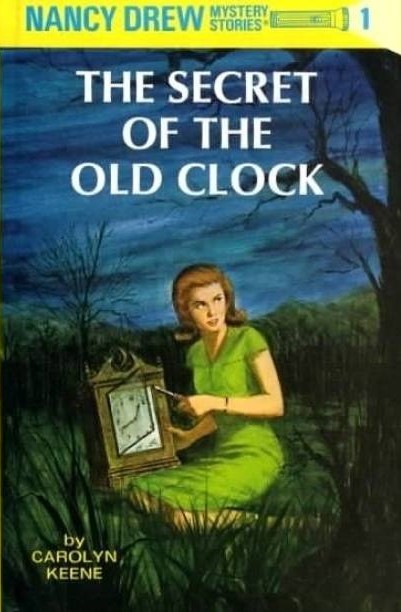

Man, I have seen the cover of this book so many times. For those of us not old enough to have lived through World War II, this is probably the version of the first book that we’re most familiar with, and it might be the most recognizable image of Nancy overall — look at her, in the middle of some random woods, whacking someone’s family heirloom with a screwdriver, staring judgmentally off into the distance. That’s what this series is all about.
Anyway, my understanding of the revisions is that sometime in the mid-20th century, the Stratemeyer Syndicate decided to save money by quite literally just printing less paper, and they set out to rewrite the first 34 books and shorten them a bit. While they were there, they also took the opportunity to remove some of the obvious ’30isms (no more telegrams or marveling at electric lights), and overall made the books less of a pre-Hays Code affair with drinking and gambling and shootouts. While the rewrites are more progressive in some ways (less racism, less of Nancy’s seething classism towards the nouveau riche), kind of interestingly, Nancy herself is a little more traditional, more demure; there’s a little more stereotypical ’50s propriety in her asking permission to go places and do things, rather than making off with people’s boats and breaking into their houses as she did in the original books. All the orgies have been cut out, too 🙁
I actually hadn’t read many of the original books before; I’d read several revised versions because those were the ones my mom and aunt had (being children of the ’60s), and I had a bunch of the Girl Detective series, which was the series published during my own youth. I’d been assuming most of them were like Shadow Ranch, which has a completely different plot across the two books, but this book is actually nearly identical to the original — it mostly just tweaks the scenes a bit, changes some names, and bizarrely crowbars in an orphan kid and a random Italian. Shall we begin?
Nancy Drew, who is now eighteen instead of sixteen, is driving back from dropping off some legal papers for Carson. We’ve barely left the first page when Nancy witnesses a moving van speeding away from a house, nearly a hitting a little girl crossing the street. The girl escapes the van, but then topples into the nearby river because why not. Luckily the river’s not very deep, and Nancy brings the girl back to her guardians no worse for wear. The guardians, two elderly sisters named Edna and Mary Turner, introduce the girl as Judy and gush over Nancy’s heroism.
The sisters immediately start expositing to Nancy that they’re Judy’s only relations (the nature of their relationship isn’t really specified); Judy’s parents were “killed in a boat explosion” some years ago. As one does. The sisters tell Nancy that Judy is a smart kid and they want to enroll her in various upper-middle-class extracurriculars and send her to college, but they don’t have much money. They used to rely on the charity of their father’s cousin, one Josiah Crowley, but he died recently and didn’t leave them anything in his will, despite telling them he would do so. The Turners bitter to Nancy that Josiah used to be cool, but he changed after he went to live with some other cousins of theirs, the Tophams. Man, is everyone in River Heights related to each other?
Nancy notes that she knows the two Topham daughters, Ada and Isabel, from school, but declines to discuss them much, as she “had been taught never to gossip.” Heh. That lesson deserts her like, five minutes into talking shit about Jake Rogers during her first case, but sure.
During their tea, the Turners realize some of their silverware is missing. They tell Nancy some random dudes had knocked on their door earlier in the day and asked if they wanted to sell some furniture, but alas! I guess you just can’t trust randos that come up to your door anymore, for they must have been unscrupulous thieves instead. Man, life was hard before you could look businesses up on the Internet. Nancy realizes they must have been the guys in the moving van that nearly hit Judy, and she runs off to report the theft.
Afterwards, Nancy goes home to ask Carson to help the Turners, and Hannah greets her at the door. In the original book, Hannah is only given a few passing mentions as “the maid”; here, she’s promoted to having helped raise Nancy and gets a bit of dialogue. The Drews all exposit that a few years ago, despite thinking that Josiah was a cross-dressing, ham-radio-using, minigolf-playing weirdo, the Tophams begged him to move in with them and despite already promising several of his relatives that he’d provide for them, Josiah left everything to the Tophams in his will instead. (Josiah also moves in with the Tophams after his wife dies in “an” influenza epidemic, instead of the epidemic after the World War.)
But after some time living together, the Tophams started shitting on Josiah so he decided to change his will a third time to leave the money to his friends and family, as he originally intended. I cannot help but think this could’ve all been avoided by 1) Josiah just leaving his money to his family to begin with (why did he leave it to the Tophams, anyway? It’s implied that maybe he felt grateful to them, but never explained fully) and 2) the Tophams not completely abandoning their plan to get Josiah into their good books for apparently no reason. Although in total fairness, I also started losing patience with this dude around my eighth game of minigolf.
Nancy’s like, “Huh, do you think there was a second will?” and Carson says, “You sound like a trial lawyer, the way you cross-examine me.” Would I be surprised if Carson has never cross-examined anyone in his life? I bet all he does in the office is Google things like “what to do when your daughter gets arrested (that doesn’t involve leaving the beach)” and “date ideas for arsonists”. Anyway, Carson says he did see Josiah meeting with an estate lawyer before his death; as in the original book, he and Nancy arrange to have lunch with said lawyer to find out the dirty details.
The next day, Nancy sets out, “becomingly dressed in a tan cotton suit.” As you do. Hannah frets about Nancy getting mixed up with the Tophams, as the two Topham girls are all salty that Nancy’s soooo popular, and they can’t stand her “through no fault of [Nancy’s] own.” Heh. Yeah, Nancy would never do anything to get on anyone’s bad side, like say, rifling through their stuff looking for evidence, or needling them about their dead relatives, or threatening to prosecute them for telling a white lie.
The next chunk of the book covers pretty much the same ground as the original: Nancy goes shopping for a dress for no real reason; the Topham girls show up and are rude and ruin the dress. Despite trying to shorten the books, they apparently couldn’t resist getting in a section about how Nancy Drew is better than you, because the scene is expanded to have Nancy get the dress for half-off and everyone has a chuckle about how she got a bargain out of the Tophams’ bad behavior.
Anyway, blah blah the employee tells Nancy that she overheard the Topham girls say that Mr. Topham thinks there might be a second will, too; Carson’s lawyer friend tells them that Josiah Crowley approached him about making a new will but never actually made it; Nancy becomes convinced that he made a new will secretly; she goes to Masonville on a random errand that results in her getting caught in the rain; she takes shelter in a barn where she meets two sisters who are related to Josiah Crowley; the Muskoka River is still weirdly located in Illinois.
(Other minor tweaks: the Masonville judge mentions having seen Josiah Crowley around town, foreshadowing the end of the book; Grace and Allie Horner are now named Grace and Allison Hoover; Carson tells Nancy about the Hoover girls’ existence so that she’s actively looking for them rather than just tripping over their farm; the reason Nancy has to take shelter is because her convertible top won’t go up. The future is now!)
The Hoover girls tell Nancy that Josiah was indeed close to them; he particularly was supportive of Allison’s dream to be a singer and was going to pay for her to have singing lessons. OMG, she could be on American Bandstand! Nancy promises to talk to her dad on their behalf and drives off.
The next day, the Hoovers come over and tell the Drews about how Josiah told them he’d put the will in a “safe place.” That wording actually sounded vaguely familiar and I’m wondering if it came up in the game? I Ctrl+F’d my own recap and didn’t come up with anything, though. I’m useless 😭 They mention Josiah was always squirreling things away in “safe places” and then forgetting where said places were; Nancy and Carson wonder if Josiah hid his new will and then forgot about it.
Nancy then surprises Allison with a visit to the town’s local music teacher, one Signor Mascagni. Italians? In River Heights? I guess it’s almost the ’60s; we don’t think Italians are too swarthy or Catholic to rub elbows with anymore. (Disclaimer: I am also swarthy and Catholic.) Signor Mascagni immediately falls all over himself to say that Allison is surely the next great star of l’opera and he’ll take her on as a student immediately. Allison despairs, for Signor Mascagni’s lessons are super expensive because apparently one of the greatest operatic vocal coaches has decided to settle in small-town Illinois, and O, where will she ever get the money for lessons. If only she were the heir of Josiah Crowley’s money instead of the Tophams!
Nancy goes out the next day and trips over the Topham sisters, who are sitting on a random bench and loudly talking about how they fear there might be another will that won’t leave anything to them, but then they cackle about how their parents surely won’t let that happen. “That was pretty clever of Mother, never accepting any board money from Josiah Crowley!” Ada (or Isabel) says. Was that clever? Whatever. Nancy has the brainwave to ask Josiah Crowley’s other relatives for clues and goes to Carson to ask for their names. Carson can’t help her there (of course he can’t), but he does tell Nancy to be careful messing with the Tophams, suggesting that Richard Topham might actually be dangerous. (Spoiler: Richard Topham doesn’t do shit in this book.) Nancy chirps that she’s not afraid of them and Carson says, “Good! I was hoping you would say that.” Oh, he wasn’t hoping that she would say she’ll be careful when dealing with the River Heights Mafia, or maybe that she’d steer clear of them altogether? What was the point of warning her, then? Maybe Carson is the unhinged one in this family and he’s been having all his “friends” contact Nancy to ask her to solve a mystery as part of a series of tests to train the fear instinct out of her.
(For what it’s worth, Nancy does promise Hannah that she’ll be careful — in fact, she’ll be “as careful as a pussycat walking up a slippery roof.” Indeed.)
Nancy goes to visit the Turner sisters again and asks after Josiah Crowley’s other relatives. The sisters tell her about Josiah’s wife’s cousin, one Abby Rowen (she’s Josiah’s old nursemaid and called “Abigail” in the original book), as well as the Mathews brothers, who were also cousins of Josiah’s. The sisters get all embarrassed and admit they used to be the Mathews brothers’ respective girlfriends, but for plot reasons never married them. Er, I’d say a double marriage isn’t really that weird in a small town, but aren’t the Turner sisters also Josiah’s cousins? That family tree is looking suspiciously Habsburgian. Anyway, the brothers live in Titusville (oh hi, setting of the game!), and Nancy decides to go there after lunch. Before she goes, there’s a whole paragraph about how special Judy is and how she’s impressed Nancy with her badminton and jump roping skills and oh, how Nancy wishes the Turners could get Josiah’s money so that Judy can get a “very special education” and put her ability to double dutch to good use. Can she not jump rope in public school?
Nancy makes the rounds around Josiah’s family again, ending up at Abby Rowen’s. As in the original, Abby has fallen and can’t get up; the revised edition expands a bit on Nancy helping her and being selfless and capable, blah blah Nancy Drew is better than you. Abby confirms to Nancy that there was indeed a second will, and Josiah told her all the information needed was in his notebook, which is…somewhere. The only other thing Abby remembers is that he also mentioned a clock, but if Josiah owned any clocks, they’re all in the Tophams’ house with the rest of his possessions.
Nancy immediately begins scheming a way into Casa Topham, but before she can so much as distract the Tophams’ cat-with-the-face-of-a-man-who’s-seen-both-world-wars with a mouse toy, she runs into her friend, Helen Corning. It’s kinda interesting that at this point we all know Helen is eventually going to be replaced by Bess and George, but Bess and George haven’t been written in any earlier and still only show up in Shadow Ranch onwards. Anyway, Helen is trying to get rid of some tickets to a charity ball so that she can go camping at Moon Lake. Nancy takes the tickets off her hands so she can use them to get into the Tophams’ house. (She still thinks they’ll serve as her “passport” into Casa Topham, but no longer considers the house “impregnable.” RIP, maybe the Tophams suffered some burglaries in the Depression.)
Blah blah Nancy goes to the Tophams’ house and they don’t want to take the tickets but then they do anyway blah. She turns the conversation to Josiah’s clock and the Tophams say they sent it up to their bungalow on Moon Lake so they didn’t have to look at something so cheap and old-fashioned. Then, hilariously, I guess they didn’t want Nancy breaking and entering like she did in the original, because Ada (or Isabel) tells Nancy that if she ever wants to admire the Tophams’ furniture collection, she has an open invitation to look around the bungalow. Heh. As one does.
“Moon Lake, here I come!” Nancy thinks. But first, let’s have a random interlude where she stops by the Hoovers’ house and waxes on about what a great singer Allison is, again, some more. Then she’s like, “Alright good talk, I gotta go to Moon Lake now.” Uh, I don’t feel like we’re doing much to trim the fat from the original novel, here.
Blah blah Nancy drives to Moon Lake, pops a tire, then fixes it in like two paragraphs (the part about her falling on her ass was removed, though, RIP), and manages to enroll in Camp Moon Lake without so much as sending word that she was coming. (Helen’s aunt owns the camp in this version, so there’s at least a reason that she can pull some strings for Nancy now.) After a few paragraphs of being annoyed that Helen, like, wants to hang out instead of letting Nancy sneak off to the Tophams’ bungalow, Nancy finally manages to get away and borrow the camp’s boat — which she asks permission to use, of course. “Full speed ahead to the Tophams’!” she says, right before the boat breaks down in the middle of the lake. Hee. If only we had some torque.
Nancy briefly considers jumping from the boat and swimming to the Tophams’, but decides against it since it would just be wrong and irresponsible to abandon the boat. Thwarted, she goes back to the camp. Eventually, she decides to just tell Helen she’s ditching her and peaces out, which is probably what she should’ve done to begin with. Helen of course is like, “But of course, I totally understand that whatever you’re doing is way more important than hanging out with me!”
Nancy drives to the Tophams’ cottage and notes that there are tire tracks nearby, and sees that most of the furniture has been moved out of the house. “I didn’t know the Tophams were moving,” she derps. However, wily readers might recall that the Turner sisters were the victims of unscrupulous thieves disguised as movers at the start of this book, and Nancy gasps that these same movers must be burgling the empty summer cottages now. Foreshadowing! This book is truly a literary masterpiece.
The thieves are indeed back, and Nancy frets that one of them is wearing a “cruel expression.” As opposed to your friendly neighborhood burglars. She tries to hide in a closet but can’t resist sneezing; they catch her and get their threat on, then lock her in the closet. Nancy once again MacGuyvers her way out and runs into the cottage’s caretaker, Jeff. He’s now white instead of black, and he was no longer lured away by the sweet sweet temptation of (illegal) alcohol; instead he was simply “hornswoggled” by those mean old burglars and locked in a shed. He despairs that the Tophams might fire him and Nancy is sympathetic instead of scolding him for not fulfilling his duty to his betters, as she did in the original.
(I mean, do I think Jeff Tucker — in both versions — probably would’ve been fired by most bosses? Yes. Do I think Nancy siding with the Tophams in the original, given that she was praying on their downfall for the entire book, was entirely down to racism/classism? Also yes.)
Nancy and Jeff report the crime to the police; Jeff is no longer a regular at the police station with a favorite jail either. The cops decline to follow the thieves because they’re near the state line, leaving Nancy to go after them alone. Oh. You guys aren’t going to alert the police in the next state over or anything? It’s 1959, I’m pretty sure we can call across state lines now. Ah, well, I guess we can’t ask for too much from the River Heights police. Anyway, Nancy heads into Wisconsin or Michigan or wherever we’re supposed to be, then loses track of the thieves, then immediately manages to trip over them at a nearby inn. No longer are they celebrating with a “drinking orgy”, instead Nancy merely finds them “eating voraciously.” Criminals with no table manners! They must be stopped!
Nancy thinks this is her opportunity to find Josiah’s clock, so she looks for their van in the barn which is most fortuitously unlocked but oh no what if the van is locked, oh wait perhaps the criminals have left the keys in the van, let’s think about where the keys could be, yes perhaps they’re under the floor mat and ah good they are indeed there and seriously, who thought this was doing anything to trim the book down? Blah blah the thieves almost catch Nancy but then they don’t; one of the thieves scolds the head thief that he’s down with stealing things from helpless old ladies, but he draws the line at locking Nancy Drew in a closet! (The thieves also now have names, by the way: “Sid” and “Jake.” Did people in the ’60s think one-syllable names were for criminals…?) Nancy manages to steal the clock and find Josiah’s diary inside, then she randomly runs into the Wisconsin/Michigan/Indiana police and tells them what’s going on — the police are blown away by what an enterprising yet upstanding citizen she is and insist on rewarding her; Nancy asks that her name be kept out of it but does request that the police talk up Jeff Tucker’s contribution a bit so that the Tophams don’t fire him (or at least so that he can find another job). Man, the book did not care this much about Jeff Tucker’s job security when he was a black dude.
The police and Nancy drive off in search of the thieves; in the original books, the cops shot out the thieves’ tires, but now they’re just like, “Stop or we’ll shoot you with our invisible guns!” The thieves swerve into a ditch and are apprehended and Nancy’s all, “J’accuse!” She says these are likely the same thieves that stole the Turner sisters’ stuff, too, because oh yeah, that was a thing that happened and we can’t be fucked not to have this resolved with one massive coincidence. Anyway, then the state trooper hilariously just commandeers Nancy’s car, saying, “I’ll ride with you…the station is on your route. You can drop me off if you will.” Heh. Don’t bother asking, my dude.
Nevertheless, Nancy clutches her pearls and decides that it would just be wrong (again, some more) not to defer to authority and confess that she has the stolen clock. “I’ll just have to face the consequences!” she thinks to herself. Fortunately for her, there are zero consequences to rolling up to a cop and being all, “Gee willikers Officer Krupke, I have some stolen property, but it was totally in pursuit of greater justice!” Listen to the Stratemeyer Syndicate, kids! Cops are your friends, so be sure to report those delinquents slicking back their hair and singing “Summer Lovin’” on the bleachers! This is so dumb, especially because Nancy justifies keeping Josiah’s notebook — she only turns over the clock — so she’s lying by omission anyway. ’30s Nancy is kicking back in a speakeasy right now, shaking her head in disappointment.
(Sidebar: while I do think the backlash against early feminism was partly in involved making Nancy less forward and brash than she was in the ’30s, I wonder if it might also be down to the changing image of adolescence, as well? Teenagers, as a concept, were just barely emerging in the 1930s — you were either a child or you were a young adult. By 1959, however, teens had solidified into a specific age group with their own culture and interests. I can imagine the adults writing these stories wanting Nancy to be more of an example to The Youth — especially with the fears around juvenile delinquency — and making her more polite and deferential as a result.)
Nancy goes back home and the book unnecessarily pads out how she eats some cake and tells Hannah all about her adventures and how she can’t wait to tell Carson but he’s at work so she’ll just have to wait but most fortuitously she has the notebook so she can read it and find out what happened to the will and OH MY GOD, WHATEVER. The notebook confirms that there is indeed another will being held at the bank under a false name. Once again, Nancy is like, “Wow, crazy how the entire plot of this book happened because Josiah was so paranoid that he nearly completely undermined his own goal of keeping the money from the Tophams.” Indeed.
Carson warns Nancy against getting her hopes up, noting that the safety deposit box may simply be the first step in a convoluted scavenger hunt that will eventually end in minigolf, ham radios, and hobo code. He tells her of a case in Canada involving a wolf and the worst board game of all time “an old Frenchman” leaving such a complex scavenger hunt for his heirs that they nearly gave up. Nancy’s like, “Okay, well, that sounds like a skill issue.”
Anyway, they go to the bank and they manage to retrieve the will in much fewer words than the original book, and Nancy and Carson walk off with “photostatic” copies of it because the future is now. I guess they establish the new will is legit and that it provides for all the non-Tophams, not that the book ever actually says this explicitly. Instead, Nancy just asks Carson if she can be present for the reading of the will — she’s much less gleefully enthused about the Tophams’ downfall as well, and it’s Carson who’s cackling about the Tophams getting “the surprise of their lives.” Man, Carson, what did they ever do to you?
Blah blah the Drews gather everyone and read out the will, the Hoovers get money for Allison’s voice lessons (fuck Grace, I guess); Abigail gets money for her medication; the Mathews get money to travel; the Turners get money for Judy’s upbringing; and only a few thousand dollars are left for Richard Topham and none for the rest of them, bye. The Tophams wail that they won’t be able to pay their bills, since they were living on the assumption that they’d come into all of Josiah’s money, and everyone just cackles that it sucks to be them.
(Weirdly, the fact that the Mathews brothers and Turner sisters used to date is never brought up again. I thought coming into money would give them reason to get married or something, but they don’t.)
The Tophams promise to fight the will, but of course they fail miserably and Nancy gets to swan around, telling everyone that they’ve come into Josiah’s money and condescending to them about how the money will change their lives. (She calls Abby Rowen “the invalid”, oh Nancy.) The furniture thieves have been caught, too, and fortunately they haven’t bothered to sell any of the heirlooms they stole from the Turners, so they get those back too. Little Judy will get to go to jump rope school! Once more, Nancy basks in the satisfaction of a case well-solved and enemies well-humiliated, then leans on the fourth wall to nudge the reader to buy The Hidden Staircase, a mystery “far more baffling” than this. I mean. Sure. Whatever. Much as I love Nancy, The Secret of the Old Clock has always been a fairly mid introduction to her world (the first chunk of the book is about how Bad and Evil the Tophams are, then it swerves to Nancy finding the will simply by tracking down some unrelated thieves; the game having Nancy actually investigate the Topham house is a lot more engaging, by comparison) and the rewrite does very little to improve it. Points awarded for removing the racism; points docked for also removing all the illustrations of Nancy in her cute ’30s cloche hat.
THE END.


Leave a Reply