
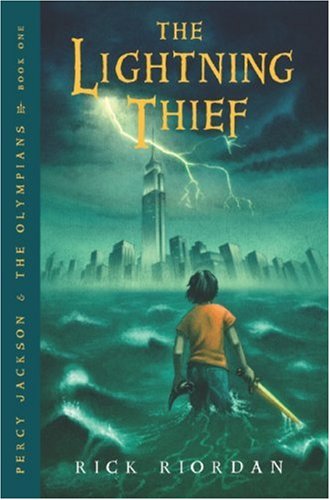
What’s up, I was looking through my blog and having a little chuckle at my own jokes, as I do, when I realized that like…all my posts for the last three years have been Nancy Drew-related — and I’m still working on those, but I figured I could mix it up a little! I loved the Percy Jackson books back in the day — I was a member of at least three PJO forums-slash-LiveJournal-communities (I remember having to defend my love of Taylor Swift from some of the Thalia-esque Green Day-loving community members) — which is a bit funny, because I wasn’t one of those kids who had a Greek mythology phase, actually. Everything I know about Greek myths comes from this series and that Nancy Drew game. Perhaps this reread will be educational for me!
Anyway, my best friend and I have been reliving our youth by watching the Disney+ adaptation. Admittedly we’ve mostly been reacting to the show with, “Wait, did that happen? Was that in the book? I do not remember that.” After the first season, I said I was going to reread the books to refresh my memory, promptly did not read the books for like, a year, but finally got around to it! As it turns out, I had in fact forgotten nearly everything that had happened in these books, including just how quick they are to read. I burned through all five books in about as many days.
So Percy Jackson is a young boy with messy dark hair and green eyes, with a two-syllable first name and a two-syllable surname*, who’s always seen odd things that no one else can. At the age of eleven twelve, he discovers that he’s a wizard demigod, and is promptly whisked away to a life of high adventure at boarding school summer camp, where he’s sorted into a house cabin based on his personality parentage (but also personality). He forms a trio with a goofy but loyal boy and a smart but socially inept girl and discovers that he’s the subject of a prophecy made before his birth, designating him as the Chosen One who will defeat a villain long thought dead but who has actually been plotting to return to life with the help of a traitorous sidekick. It is revealed partway through the series that Neville another demigod could have been the Chosen One, but circumstances cause it to fall upon Percy’s shoulders instead. And then he fights the mean old Slytherins children of Ares for the Quidditch Cup Capture the Flag laurels.
I mean, I don’t think this series is bad for having so many similarities to Harry Potter — it’s not like that stopped my enjoyment of it at all and it was hardly the only one, especially in the 2000s — and PJO certainly grows into its own over time. Even within the first book, how the characters actually act and the arcs they go on deviate from HP quite a bit. Buuuut I’ve seen the argument that PJO is totally different than HP, and that they’re only similar inasmuch that they’re both middle-grade-fantasy-Hero’s-Journey stories, and I think that’s a leetle disingenuous. I do think it’s worth pointing out how many of the plot beats and how much of the PJO series’ scaffolding resembles HP, if only as context for the cultural milieu the books were published in.
(* I realize this sounds nitpicky, but I think there’s a logic to it! Harry Potter and Percy Jackson have a similar bouncy rhythm, with a casual nickname and then a surname bisected with a snappy plosive consonant. I mean, I highly doubt anyone involved was giving it this much thought, but maybe subconsciously Rick Riordan felt that Percy Jackson made a catchy name for the same reason Harry Potter did.)
Aaaanyway. We open with Percy warning the reader that if you are interested in stories with happy endings, you would be better off reading some other book. In this book, not only is there no happy ending, there is no happy beginning and very few happy things in the middle. This is because not very many happy things happened in the lives of the three Baudelaire youngst — oh wait, wrong book.
Percy tells us that his life is miserable and dangerous and it all started when he went on a field trip to the Met with his school. He goes to a school for “troubled kids” in New York; he exposits that he has ADHD and dyslexia and weird things have always kind of happened around him, but since he’s such a bad student, authority figures never believe that he doesn’t mean to cause trouble. One thing I think these books do quite well is Percy’s background and mistrust of authority figures — it would’ve been easy to make him sassy and contemptuous of adults because he’s naturally confident or smarter than they are, a la Artemis Fowl and Maximum Ride (both of whom I also loved as a kid, to be clear!), but Percy is a lot more realistic as a kid stuck in that feedback loop of trying your best, adults being convinced that you’re purposely failing and punishing you, you lose your trust in authority figures and stop obeying them, which causes them to treat you even worse, rinse and repeat. Rick Riordan wrote this series for his son, who has ADHD and dyslexia, and it feels like he has a better understanding of and sympathy with kids termed “difficult” than the average YA author.
Percy has exactly one friend at the school, a weird, nebbish, “crippled” kid named Grover; he also gets along with exactly one teacher, his Latin teacher, Mr. Brunner. Mr. Brunner takes everyone in to see an exhibit about Ancient Greece (despite teaching Latin, this man does not ever bring up Rome), and he asks Percy a bunch of pointed questions about the Titans and Kronos and how all this might affect Percy in real life. Percy’s like, “It…won’t? Because Greek mythology…isn’t real?” and Mr. Brunner heaves a big sigh of foreshadowing.
The plot gets going pretty quickly: a teacher named Mrs. Dodds notices Percy getting into it with another girl in class — notably, he somehow makes water from a nearby fountain rise up and splash her. File that away for later. Mrs. Dodds hauls Percy off to scold him about how She Knows What He Did and He Won’t Get Away With It, and Percy’s like, “Is this because I stole my Tom Sawyer essay off the Internet?” Heh. Oh, the days before Turnitin.com, or whatever the kids are using these days. (Percy: “They were going to take away my grade. Or worse, they were going to make me read the book.” Hee.)
But no, Mrs. Dodds is upset about more than Percy’s academic integrity — not that she says what she actually thinks Percy’s done, because then we wouldn’t have a book. Instead, she just turns into a winged monster and tries to kill him. As you do. Mr. Brunner rolls in (he’s in a wheelchair) and tosses Percy a sword, which he manages to swing at Mrs. Dodds to kill her. When the dust settles, both Mrs. Dodds and Mr. Brunner are nowhere to be seen, and Percy’s left standing with a ballpoint pen in his hand. Percy goes to find Mr. Brunner, who immediately starts gaslighting him about how he’s been outside the entire time and that ballpoint pen sure is just a pen and also, he’s never heard of Mrs. Dodds in his life.
We cut ahead to the end of the school year. Percy is weirded out that everyone in school has been acting like Mrs. Dodds never existed at all — except for Grover, who’s trying to pretend, but kind of sucks at lying. One night, Percy goes poking around and overhears Mr. Brunner and Grover talking about him. Behind his back! The betrayal! They’re talking ominously about how Percy saw what Mrs. Dodds really was and how they know about him and it’s almost the summer solstice and Grover can’t fail again and they really gotta worry about keeping Percy alive until next fall. Percy is obviously not pleased to overhear all this.
School lets out for summer; Percy’s been frustrated over the whole everyone-gaslighting-him-about-nearly-getting-murdered thing and has been acting out; the school tells him not to come back next year. Percy packs up, bittering about how all his classmates are rich delinquents whose shitty behavior is getting rewarded with trips to Switzerland, while he’s just going back home to NYC to stay with his mom and stepdad. In a novel twist, Percy’s mother is alive, and he’s actually quite close to her and affectionate with her — this feels pretty rare for fantasy fiction, much less a story focusing on middle school boys. Again, I like Percy’s characterization a lot — he’s once more very realistic as a normie kid among his wealthy classmates.
Percy and Grover take the same bus back into the city, and Percy takes the opportunity to bring up that hey, he overheard Grover and Mr. Brunner talking about how Percy’s gonna die real soon, and he finds that perturbing! Grover gets super twitchy and won’t explain what’s going on, but he does give Percy his business card — what sixth-grader doesn’t have one? — saying that he’s a “Keeper” who works at “Half-Blood Hill”. He tells Percy that he has to protect him, but before Percy can press him about that, the bus breaks down in a way that seems like it should be related to the plot but isn’t really.
On the side of the road, Percy sees three old women knitting, and one of them ominously cuts a string of yarn. They are very obviously the Fates and have just cut someone’s thread of life, but I guess Percy really wasn’t paying attention in Greek/Latin class, because he doesn’t twig to this at all. Grover does, however, and starts freaking out about how this always happens and why him and why don’t they ever make it past sixth grade. Percy tries to ask him what the F he’s talking about, but Grover just keeps going “WHY SIXTH GRADE???” on repeat. Heh. But why male models?
They make it back to the city, and Percy promptly ditches Grover at the Port Authority. Hey, I too have been to the Port Authority! That’s where the bus would pull in for my one (1) day of having fun in New York when I had to visit my family in Jersey every summer (the rest of the trip would be tense family dinners and helping my grandma grocery shop in Weehawken). This book is basically a biography of my life. Anyway, Percy heads home and crash-courses us on how his biological dad was some “rich and important” sailor dude whom his mother (“Sally”) had a fling with, who then promptly disappeared before Percy was born. Despite this, Percy vaguely remembers his dad’s general presence and vibe, but doesn’t actually know anything about him. Sally has since married the subtly-named Gabe Ugliano, who drinks and gambles and is implied to hit Percy every now and again when he won’t hand over his allowance. And also he’s bald.
Sally comes home and tells Percy that they’re going on a mother-son trip to their beach cabin in Montauk, like, right now. (Okay, maybe scratch what I said about Percy being a super realistic working-class kid.) Percy is jazzed for about three seconds before realizing that his mother seems tense about something. He’s like, “Should I tell her about the growing signs that I’m a fantasy protagonist?” but then decides that it would just stress her out even more. He then goes off into an aside about how he and his mom have a little bonding ritual where they eat blue-colored food together, like blue corn chips and blue candy, because Gabe once said blue food didn’t exist and it’s their way of sticking it to him. It’s cute and comes up multiple times but has no bearing on anything that happens, so let’s move on.
(Percy’s mom also mentions that she met his father on the beach in Montauk. Do you think maybe his dad has something to do with the ocean?)
Percy and his mom chat about how he’s probably going to have to go to another boarding school. Percy bitters that his mom doesn’t want him around, because he doesn’t have abandonment issues at all, and his mom says she’s only trying to keep him safe. Percy flashbacks to all kinds of weird things that have happened to him — a creepy guy with one eye following him at the playground, a snake appearing in his cot at daycare, water splashing his classmate, etc. It’s very early Harry Potter turning his teacher’s hair blue and jumping onto the school roof. Anyway, Sally frets that she might finally have to send Percy to a special place…a far away place…a dangerous place from where there is no turning back…a summer camp. She tells Percy his father wanted him to go to this camp, and Percy thinks that it’s weird that his father was apparently arranging his extracurriculars before he was even born and also that his mom is crying over sending him to camp like hundreds of parents don’t do that every year, but he doesn’t press further for some reason.
Percy goes to sleep and has weird, ominous, not at all plot-related dreams about Zeus and Poseidon an eagle and a horse fighting while a disembodied voice cackles evilly that all is going according to keikaku. When he wakes up, a bizarrely unseasonal hurricane is raging, and Grover is at the door, and he’s not wearing pants. Percy’s like, “Why does Grover have cloven hooves?” while Grover and his mom both yell at him for keeping all the ominous plot stuff from the first three chapters a secret. Percy’s like, “In my defense, I didn’t know that that was foreshadowing.”
Grover says that something is coming, so they all pile into Gabe’s car and drive off. In the car, Grover reveals that he’s a satyr, because satyrs are real, and his vague disability was because he has to wear fake feet to cover up his hooves. Mrs. Dodds was also real and is a minion of one “Lord of the Dead”, and anyway, we’re bailing to the mysterious dangerous summer camp right now, so questions later, please! They manage to make it pretty close to the camp, but then lightning strikes the car and blows it up. Everyone miraculously manages to survive, though, don’t worry. (Percy, checking on Grover: “I shook his furry hip, thinking, No! Even if you are half barnyard animal, you’re my best friend and I don’t want you to die!” Hee.)
In the distance, Percy can finally see that they’re being chased by the Minotaur, though he doesn’t recognize it as such — he just thinks it’s some weird half-bull creature. Who’s wearing Fruit of the Loom underwear. Sure. I can only assume that caused great amusement for the ten-year-old boys reading this. They all make a run for it, but the Minotaur manages to grab Sally and make her disappear. Percy goes crazy with grief and adrenaline and manages to break the Minotaur’s horn off and vaporize him with it, then he and Grover make it across the camp border and Percy passes out. He comes to long enough to see a girl about his age hovering over him; with his love interest introduced, he conks out again.
Percy wakes up for real this time in the camp infirmary. After chugging some healing potions ambrosia, Grover takes him to the camp main house, where Percy meets in short order: Mr. Brunner, who’s actually a centaur named Chiron (the wheelchair was for hiding his, uh, bottom half); the girl he saw earlier, who Grover introduces as another camper named Annabeth; and the camp director, Dionysus — Mr. D if you’re nasty to all the whippersnappers around here, as using the gods’ real names is a Very Serious Thing and one should Never Do It, except pretty much everyone forgets this in about three chapters. Mr. D hates kids and is only here because his dad is punishing him for chasing some wood nymph tail — his dad being Zeus, of course. Percy’s like, “Wow, this conversation is really weird” until Chiron finally spells out for him that Greek gods — and monsters — are real. (Percy: “God is real?” and Chiron’s like, “Okay, let’s not get into that one, this book is for middle schoolers.”) Muggles Mortals can’t see things like monsters or Half-Blood Hill, as all mythological things are surrounded by a “Mist” that tricks mortals into seeing mundane explanations for any godly activity. The gods move wherever the “heart of Western civilization” is, which means that right now, they’re in New York. USA! USA! (Let’s not ruin this by asking what they were up to on September 11 a mere four years before this book was published.)
Also, Mr. D reveals that “Percy” is short for “Perseus”. And this kid still didn’t realize he was half-Greek (god)?
Percy finally asks what any of this has to do with him, and Chiron’s like, “Shh, we’re saving that reveal for later.” Time for a tour! He leads Percy around the camp and all the kids stare at him because he’s the Boy Who Lived he slayed the Minotaur. Chiron tells Percy all about the wholesome summer activities everyone gets up to, like archery and chariot racing and sword fighting, the latter of which he cheerfully assures Percy isn’t usually lethal. The whimsical, ha-ha-things-in-this-world-can-kill-you-isn’t-that-quirky vibe is also very reminiscent of HP and Harry’s introduction to Hogwarts and Quidditch, for anyone keeping count. Percy also asks Chiron if Grover is going to be in trouble for the whole nearly-getting-Percy-killed thing, and Chiron alludes to Grover having already failed in keeping another camper safe — which is kinda embarrassing considering he’s like twenty-eight years old. (Satyrs age slower than humans, which means that Grover has been a middle schooler for a while. Percy correctly notes that being in seventh grade for six years would suck hard.)
Percy muses that if Greek gods are real, the Underworld must also be real, which means that dead people aren’t really dead, right? And if he wanted to, say, retrieve his mom, that would be doable, right? Chiron cuts that line of inquiry off with a quickness, not that it stops Percy (and the reader) from tucking that possibility away for later.
Chiron shows Percy to the cabin area, which is set up with twelve cabins for the twelve major Olympians. (There are kids of other, minor gods hanging around; as far as I can remember, we never get a real explanation of where they’re meant to be sleeping. Maybe the sequel series explains it; I haven’t read those books.) All the cabins are themed after their patron god; e.g. the Poseidon cabin is covered with seashells and smells like salt; the Ares cabin has a dead boar on the door, as one does. Percy is assigned to Cabin Eleven, which belongs to Hermes — all new kids are placed there until they’re sorted claimed by a godly parent, as Hermes is the god of travelers. (And thieves. Percy reminds himself not to leave his Minotaur horn lying around. Hee.)
Chiron hands Percy off to Annabeth, who’s all tsundere and unimpressed with his Minotaur slayage. She, in turn, introduces him to the Hermes counselor, a college-aged kid named Luke. (No mention of the sweet Halo setup he has in the movie, sadly.) Luke is friendly and welcoming to Percy and Percy immediately thinks he’s the coolest senpai around. (Admittedly, not like there’s competition.) Percy asks how long it’s going to take him to be sorted claimed, and Annabeth drags him off because he’s making her look uncool in front of Luke, who she totally doesn’t have a crush on. She tsunderes some more that Percy is being so dumb and she can’t believe she thought he was the one. Percy’s like, “I mean, I clearly am the one for you because we’re going to end up together, but also, what are you talking about?” Annabeth hints that Percy is one of them: he’s got dyslexia because his brain is hardwired to read Ancient Greek and he has ADHD because he has hardwired battle reflexes (I’m not sure that’s how learning disabilities work), and his father isn’t dead, he’s —
Oh, wait, we’re not doing the reveal yet. They’re interrupted by one of the Slytherins Ares kids, a girl named Clarisse, who taunts them about how she’s going to kick their asses at Quidditch Capture the Flag. Percy doesn’t particularly want to fight the Ares kids — who, in classic 2000s bully fashion, are all exaggeratedly big and mean (Clarisse specifically is a “size XXXL”) — but knows he can’t call Chiron for help lest everyone mock him for being a big old baby. Clarisse drags him off to the toilets (while Annabeth watches through her fingers, way to help, girl) and tries to dunk him, but suddenly a bunch of water shoots out from the toilets and sinks and drenches the Ares kids. Clarisse is not at all pleased and snarls at Percy to watch his back.
Anyway, villainous introduction over, back to the exposition! Because Percy still hasn’t figured it out: yer a demigod, Percy! Your father isn’t dead, he’s a Greek god! And now you’ve gotta stay here, at Camp Half-Blood, which is a place for demigods to live and train to fight all the mythological monsters that want to kill them. Monsters can’t get inside the camp, unless they’re intentionally let in for practice or as a “practical joke.” Monsters also don’t care too much about kids of weakling gods like Aphrodite and Demeter*, so those kids can leave after the summer and generally live normal lives, but the children of powerful gods basically spend the rest of their lives running from-slash-fighting monsters, and they have to live at the camp year-round for protection (until…they grow up and get their black belts in mythological monster fighting? The main series doesn’t introduce any adult, post-camp demigods, although like I said, I haven’t read any of the sequel series).
*The book has a tendency to correlate importance to monsters with physical strength or ability in battle, which is why children of Zeus, Ares, and Athena are important, while kids of Dionysus or Aphrodite, who Percy observes can both drive people to madness, are not. Make of that what you will.
Annabeth, for her part, is a daughter of Athena, but admits that not all kids know who their parents are — the Greek gods, as we know, are fond of fucking around and not taking responsibility for where they put their dicks — or vaginas, quoth Annabeth, “You assume it has to be a male god who finds a human female attractive? How sexist is that?” Equality! The result is that a lot of kids end up dumped in the Hermes cabin and never get claimed. (Sidebar: I really like the themes of parental abandonment and seeking approval that run under the surface of the story. Admittedly, the series doesn’t always explore them as deeply as it could, but even the attempt feels novel and pertinent to the series’ audience.)
Apart from the occasional field trip, the only way to leave camp is by being assigned a quest, which Annabeth has been jonesing for pretty much her entire twelve-year-old life so that she can go out and prove her strategic battle abilities or whatever. Uh, didn’t she spend Clarisse’s entire hazing of Percy hiding behind her hands? That wasn’t very Alexander the Great of her.
Annabeth says the last camp field trip was at the past winter solstice, when they all took a trip to Mount Olympus. (It’s on the 600th floor of the Empire State Building. Obviously. Percy: “As far as I knew, there were only a hundred and two floors in the Empire State Building, but I decided not to point that out.” Heh.) After they left, the weather started getting weird — the sky is Zeus’s domain and the sea is Poseidon’s, and it’s like they were fighting! “That’s crazy, because I had a prophetic dream about those two fighting,” Percy doesn’t say. Annabeth has since heard rumors that something was stolen from one of the gods, and shit is about to go down if it’s not returned. She’s convinced she can girl detective her way to the truth, and she’s hoping Percy’s battle with the Minotaur is indicative of something special about him, like maybe being the protagonist of the book whose party she can join. As long as he’s not a kid of Ares or Poseidon, whom Athena doesn’t get along with, they should be cool!
Luke comes to pick Percy up for dinner. Based on Luke’s resemblance to several other kids in the cabin, Percy figures out that he’s an actual child of Hermes, and he’s like, “So having Nathan Fillion and/or Lin-Manuel Miranda as your dad is pretty cool, huh?” and Luke’s like, “I hate Firefly and Passing Strange should’ve won the Tony instead of In the Heights >:(” Just kidding. He does, however, get suspiciously bitter when his father is brought up. He also mentions that, ever since one of his own quests went awry a couple of years ago, there’s been a total ban on quests, so Annabeth’s dream of leaving Camp Half-Blood is kind of dead.
Percy doesn’t press, and they all go to dinner, where everyone is divided by house cabin, and the tables magically spawn food. This sure doesn’t remind me of anything! They make some burnt offerings of their food to the gods, and Percy asks his dad to acknowledge him. Then Mr. D gets up and announces to everyone that their Capture the Flag game is coming up, and Slytherin Ares currently holds the Quidditch Cup laurels. After dinner, they do camp stuff like roasting marshmallows and having sing-alongs, and Percy’s happy to finally feel like he fits in somewhere.
The chapter ends here, and so will this post! Up next: Capture the Flag is serious business, Percy’s absentee father comes back into his life (join the club, my man), and it’s soooo impossible to get a quest, we definitely aren’t going on one.

Leave a Reply