
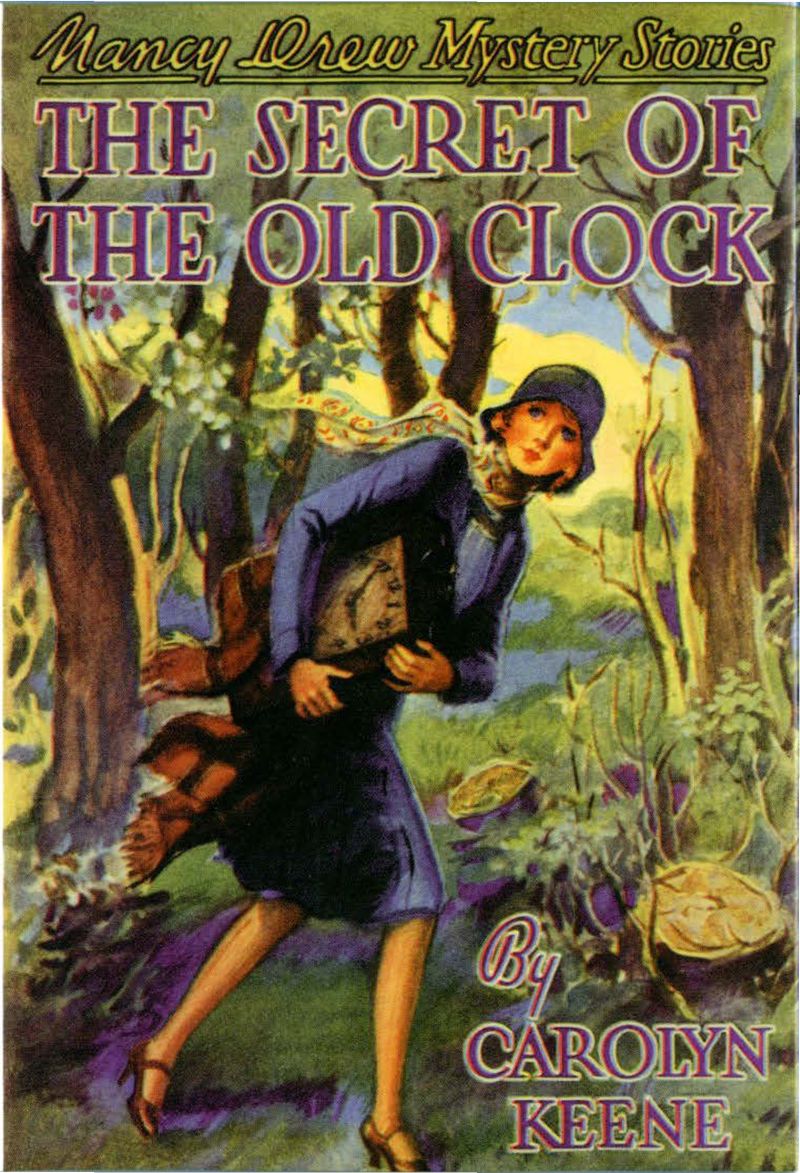
The first Nancy Drew book, everybody! The game Secret of the Old Clock, you’ll recall, went back to Nancy’s roots with a detour to the 1930s for the setting, pulling primarily from the first four Nancy books: The Secret of the Old Clock, The Hidden Staircase, The Bungalow Mystery, and The Mystery at Lilac Inn. The end result was something like a mystery of an old clock hidden in an inn with a secret staircase. (IDK where bungalows come into it.) Never let it be said those games weren’t economical. (By the way, I think I mentioned in the game recap that I didn’t know why they’d suddenly wanted to do an homage to the early Nancy Drew books, but ten(!) years later, I finally figured out that it was because 2005 was the 75th anniversary of the series. Cute.)
However, I have always been more ambitious than I am smart (props to the Sims 2 CC maker who introduced me to that phrase; they probably didn’t know they were creating a load-bearing part of my lexicon when they were talking about making 200 recolors of a shirt or whatever). Thus, let’s attempt to do all of the books that the game was based on, both the original ’30s versions and the ’60s rewrites, for eight books in total. Look, man, I’ve been having a rough time and I gotta keep busy, okay?
So here we are, where it all began! It’s 1930, the war is over, Prohibition hasn’t been repealed yet, and we’ve just discovered Pluto, which is definitely a planet, stop asking questions.
Nancy Drew, “a pretty girl of sixteen” (not eighteen as she becomes in the revised books and games — which, by the way, I guess makes the Clue Crew sixteen when they’ve got a doctor and a lawyer hitting on them), is hanging with her dad Carson, ranting about the recent death of one Josiah Crowley. She’s irritated that he left all his money to a family called the Tophams, as they’re a bunch of no-good-dirty-rotten-social-climbers with no redeeming qualities whatsoever. She’s sure the Tophams only let Josiah live with them so they could somehow worm their way into his will, which is what they appear to have done. Carson marvels that Nancy’s “curly golden bob” could contain such serious thoughts, instead of silly girl things like crashing her car and having affairs with Frank Hardy.
The book exposits that Josiah Crowley, after the death of his wife (in the influenza epidemic after “the” World War, because there’s only been one, you know!), somehow became homeless and eventually was taken in by the Tophams. Despite offering him their house, the Tophams treated Josiah like garbage, and everyone thinks they were just waiting for him to die so that they could inherit his fortune (which he was leaving entirely to them because…they took him in? I don’t know). Nancy thought Josiah had gotten hip to the Tophams’ sketchy ways before he died, and she wonders if he made a new will cutting the Tophams out.
Carson suggests that, if he did, the Tophams would make sure the new will won’t be found. The book notes that, due to being raised by a lawyer, Nancy has “acquired the habit of thinking things through to their logical conclusion”, and the logical conclusion Nancy draws is “So there definitely is a secret will and I personally have to snoop around and find it before the Tophams do!” And thus, our favorite nosy girl detective is born.
Nancy presses Carson to ask Josiah’s lawyer — who’s a friend of Carson’s because whatever, who isn’t friends with Carson — if Josiah made a second will. IDK about 1930s laws but I feel like there’s some confidentiality issues there? But whatever, Nancy’s sure Josiah’s lawyer will tell Carson everything because he’ll just be soooo flattered that Carson Drew is even asking about his work. Carson agrees, thinking to himself that it’s for a “good cause”, that cause being that Nancy personally disapproves of who Josiah left his money to.
The next day, Nancy goes shopping, as she’s been invited to a party and the book goes off on a tangent about how Nancy is super popular because she’s good at everything and yet not snobby or mean. Hey, I’ve never accused her of being those things; I’ve called her sanctimonious and judgmental, which is totally different. Anyway, at the shops, Nancy runs into the Topham sisters (“Ada” and “Isabel”), who are berating one of the employees because they are are snobby and mean, and ugly to boot. Nancy nods at them and they give her the cold shoulder; Nancy huffs that she “won’t even bother to speak to them” next time. Uh, you didn’t speak to them this time either, Nancy. After the sisters leave, the shopgirl complains about them to Nancy and opines that the Tophams are worried that they won’t get Josiah Crowley’s money after all, for some mysterious reason. Nancy is intrigued.
Nancy goes to meet Carson, greeting him with, “What luck, father?” I didn’t realize people spoke like that in the 1930s and not like, the 1630s. Carson is like, “Are you sure you want to needle one of my colleagues over a case that’s really none of our business?” and Nancy says, “I can’t tell you why, but I just seem to know that Josiah Crowley made a second will.” Oooh, I can tell you why! It’s because Mildred Benson couldn’t be fucked to think of a better impetus for the plot! Anyway, Carson’s lawyer friend tells them that, before he died, Josiah Crowley did approach him about making a new will and said he’d bring it back for review, but he never did. Lawyer Friend sighs that the Tophams will surely get all of Josiah’s money no matter what.
Once again, Nancy’s takeaway from that conversation was that Josiah Crowley definitely, totally made a new will and it’s just a matter of finding it to make sure the Tophams never, ever get their hands on his money, an outcome she is personally invested in stopping for whatever reason. Carson’s like, “Okay, but do you even know where to start looking?” and Nancy’s like, “Stop saying words.”
Nevertheless, some undetermined time later, Carson asks Nancy how the case is going, and Nancy admits that she’s made no progress. Carson’s like, “Rough life. Hey, maybe you should try doing chores; that’s always a good way to advance the plot of the game your mystery.” He tasks Nancy with delivering some papers to a judge in “Masonville” (wherever that is) and thus, Nancy sets off in her roadster. As she drives, the book tells us, “Like a true daughter of the Middle West, Nancy Drew took pride in the fertility of her State and saw beauty in a crop of waving green corn as well as in the rolling hills and the expanse of prairie land.” HEE. I can’t say I think about my state’s fertility all that often, but I’m a mere daughter of the West Coast, so I mostly spend my drives on the I-5 thinking that I’m going to get squashed by a trucker. And also that there are no cows in Vacaville, which is a thought I get every time I pass that town.
As Nancy drives, she worries that it might rain, but when she meets the judge, he’s like, “Eh, probably not.” Nancy’s like, “Cool” so she drives back and then it starts raining. Heh. (Weirdly, the book notes that she’s driving along the Muskoka River, which is in Canada IRL. Why they have transplanted it to Illinois for this book, I do not know.) She eventually takes shelter in a barn, which happens to be owned by two sisters, Grace and Allie Horner. Allie immediately recognized that Nancy is the daughter of “Carson Drew, the noted lawyer” — not that she’s ever met him, she just knows of him because Carson’s apparently a household name. Again, I ask, for what? How is Carson famous just for being a lawyer? Did he defend OJ?
The Horner sisters are orphans and have inherited their parents’ farm, although they’re having trouble making ends meet. They reveal that they knew Josiah Crowley, who was a family friend and their neighbor until he moved in with the Tophams. The sisters say that Josiah promised to take care of him before he died, but obviously that didn’t come to fruition in his will. Nancy is convinced some more that there must be a second will and that the Horners definitely deserve the money more than the Tophams, even though she met them like five minutes ago and knows nothing about them.
A couple of days later, the sisters come over and tell Nancy and Carson that Josiah did tell them he made a second will, but he probably hid it somewhere in the Tophams’ house instead of like, taking it to the lawyer, because he was quirky and silly like that. Nancy resolves to find it, again, some more. I mean…we’re five chapters in, Nancy, we could get cracking on this. Is she not itching to do some breaking and entering? This is hardly the Nancy I know.
Another vague stretch of time passes in which Nancy does nothing. Today, though, she’s going shopping! The Horners will be thrilled to hear that, I’m sure. The Topham sisters are at the store again and Ada breaks a vase and tries to blame it on an employee, but Nancy steps in and tells the manager what really happened. The manager says Ada has to pay for the vase and Ada seethes that Nancy will pay for getting on her bad side. The employee frets that the Tophams will try to hurt Nancy and Nancy’s like, “Pfft, as if the Tophams could ever do anything to me, Nancy Drew.” I bet that’s what Jimmy Hoffa thought, too.
Nancy follows Ada and Isabel, and overhears them discussing Josiah’s will. They also think a second will might’ve been made, but they don’t know where it is either, so they’re not worried anyone else will find it. Nancy is encouraged that the Tophams haven’t had the chance to find and destroy the second will and resolves to find it before they do. “I must get busy!” she thinks to herself, but tragically this book is about seventy years too early for Sean Paul to start playing in the background.
The book tells us that Nancy delights in “a battle of wits” when it comes to a mystery; this is demonstrated by her taking seven chapters to consider that she should talk to some of the other Crowley relatives who might’ve been in the second will. Carson refuses to help her, as I guess it’s legally sticky to tell her who might’ve also been in the will, although I don’t see how, given how everyone seems to know who Josiah Crowley is, Nancy’s also unaware of who his relatives might be. Anyway, she visits the Horners to ask for help and thinks about how poor they are and how she simply must help them for it pains her to watch them bear their poverty so pluckily, et cetera.
The Horners tell Nancy where to find some of Josiah’s relatives. The first few she visits (the “Mathews brothers” and the “Turners”) are useless, but they point Nancy to Josiah’s old nursemaid, one Abigail Rowen. Abigail lives out in the middle of nowhere and has nary a friend in the world; when Nancy finds her, she’s lying on the floor because she fell down (and couldn’t get up again) and nobody came to check on her. Also seventy years too early for Life Alert 🙁
Like the Horners, Abigail is broke and was relying on Josiah’s will to take care of her. She tells Nancy that Josiah also told her that he’d written a second will that didn’t involve the Tophams (although bizarrely, he apparently wrote it around the same time he moved in with them?) and he’d tricked everyone and was going to squirrel it away where no one could ever get to it. After some hemming and hawing, Abigail eventually remembers that Josiah’s will was in a notebook, and he said something about a clock as well. Nancy thinks the will might be in Josiah’s clock, which would still be in the Topham house. Gotta say, I’m not sure what Josiah’s master plan was here, what with writing a second will that he told no one about while simultaneously moving all of his possessions — including the item holding the will — into the home of his mortal enemies. Being obsessed with Shakespeare, cross-dressing, and minigolf is starting to seem like the more sensible explanation for his actions here.
On the way home, Nancy runs into a “chum” of hers, one Helen Corning. Oh, hi, Helen! This is our first time meeting her; she’ll be Nancy’s best friend until about book #5, when she’s unceremoniously demoted in favor of Bess and George. Rough life. Helen tells Nancy that she’s trying to sell tickets for a charity dance; she’s hoping to get rid of them so that she can head off to “Moon Lake” tonight. Nancy hits upon selling the tickets as the perfect ruse to get into the Tophams’ house and volunteers to take them off Helen’s hands — “These tickets will serve as my passport to the impregnable Topham fortress!” she thinks to herself. Uh, sure. Is it that impregnable, Nancy? You can’t get in by letting Richard Topham test your psychic abilities?
Anyway, Helen hands the tickets over and happily sets off to Moon Lake, where she’ll presumably only smoke if she’s on fire. Nancy heads over to the Tophams’ the next day, naturally taking the time to note how tasteless and nouveau-riche their house is. I’m glad we’re prioritizing. After fussing about the tickets because Mrs. Topham is too stingy to spend money on them but Mr. Topham argues donating to charity would make them look good, blah blah blah, Nancy eventually finds out that they thought Josiah’s clock was ugly and sent it up to their “bungalow on Moon Lake.” OMG, are we going to Moon Lake, too? Are we going to knock out a mystery about ghost dogs while we’re there? (Also, if there’s already a bungalow in this story, then what the hell is The Bungalow Mystery about? How many bungalows could possibly appear in the first few books of this series?)
Nancy decides to join Helen, who’s at a “girls’ camp” on the lake. On the drive up, she pops her tire but fixes it in like two minutes and sets off again, in what I think is meant to be a role-model moment for her. Just because she’s a girl, that doesn’t mean she can’t get herself out of a pickle! (Also, props for the visual image of Again and again she pulled, but the huge balloon tire could not be budged. Then, as she gave one mighty tug, it came off and Nancy Drew fell backwards into a sitting posture in the road. Hee.)
Nancy arrives at the camp and is somehow able to register upon arrival and no one questions her just showing up after camp’s already started. Different times, man. (And I wrote that sentence before I saw the next paragraph, where Helen refers to the “negro caretaker” who looks after the Tophams’ bungalow when they’re away. Yes, we are going to meet the caretaker, and yes, it’s going to get so much worse.) Said caretaker is one “Jeff Tucker”, which…don’t tell me Jeff Akers is a reference to this guy.
Anyway, Nancy plans to take a boat out to visit the Tophams’ bungalow, and Helen not-at-all subtly warns her that the motorboat’s engine isn’t very good. Sure enough, the engine dies and strands Nancy in the middle of the lake. (The book notes that Nancy can’t fix it herself because Like most girls, she had never interested herself in the mechanics of what made wheels go around. Uh, didn’t she just change a tire by herself like two chapters ago? Whatever.) Nancy says, “Hateful thing! I believe it stopped on purpose!” which in total fairness is how I felt when I had to reinflate my car tires recently. She waits for rescue for several hours before deciding to try to fix the engine herself; naturally it starts working and Nancy is pissed that she wasted a whole day stranded on the lake. Aw. I won’t even make fun of this because I feel like that’s the exact type of thing that would happen to me.
A few days later, Nancy departs the camp, since Helen is under the mistaken impression that Nancy came here to hang out with her and Nancy is all annoyed that she won’t leave her alone long enough to let her stake out the Tophams’ bungalow. Heh. Oh, Nancy. Nancy ends up driving the long way around the lake to the bungalow, but upon arrival, she sees that it’s been ransacked by burglars and the clock’s not here. Of course it isn’t. The thieves turn out not to have left and they come back and catch Nancy. Nancy’s all, “What you’re doing here is highly immoral and should I get the chance, I’ll turn you over the police!” The head thief cackles and is like, “You can’t report us to the police if we lock you in the closet!”, which they promptly do. Nancy’s like, “Man, I really wish I hadn’t ditched Helen.” Heh.
Nancy manages to MacGuyver her way out of the closet (by using the clothing rod to lever the door open, should you ever find yourself in this situation, although the fact that closet doors are no longer made of “heavy oak” probably makes this less likely. And also because an actual burglar would probably just shoot you) wherein she’s finally rescued by Jeff Tucker. He is an incredibly 1930s depiction of a black person, by which I mean “super racist.” The book repeatedly refers to him as “colored” and he talks exclusively in dialect (“Say, white gu’l, you tell me wheah all dis heah fu’niture is at!”). He admits that he was lured from his post at the bungalow by some white dude who offered to take him out drinking and then stole his keys when he passed out. (This ploy worked because the book implies “colored people” are just too simple to resist the sweet lure of alcohol.) Nancy scolds him for abandoning his duty and betraying the Tophams. Nancy, you’re actively working to disinherit them with, like, zero legal basis. Let’s not act like you care about anyone’s loyalty to the Tophams here.
(Somewhat weirdly, I must add, the head thief told Nancy that they would do away with her “just like” they did with Jeff but clearly they didn’t try the same tactic? This book would’ve been so much funnier if they’d gotten Nancy totally hammered.)
Jeff tells Nancy that there was indeed a clock here at the bungalow, but the thieves have taken it now. They can’t call the police because there’s no phone, only “the R.F.D.” I Googled and I’m not sure what this means — it seems like the most common abbreviation of the time would’ve been “Rural Free Delivery” for the mail, but that doesn’t seem to track as a replacement for calling the police. Something to do with the radio, maybe? Anyway, they drive down to the station, which Jeff is familiar with because he’s always getting arrested for “enjoying [himself]”, once again with the implication that he’s just too simple to enjoy himself in non-criminal ways, whatever those are. (Then he chirps, “This is my favorite jail!”, as one does.) They alert the police, who decide to go after the thieves — but oh no, there are two routes out of Moon Lake! Which one should they take! Nancy points out that one road leads to a larger town in which the thieves can sell their ill-gotten goods; the other road leads to nowhere in particular. The police are like, “Good call, you take the road towards the town that the thieves are probably going to; we’ll take the random dead end.” Moon Lake’s finest, everybody.
Naturally, Nancy is the one to encounter the thieves — they’ve stopped halfway to town to indulge in a “drinking orgy.” Not drinking! Prohibition won’t be repealed for another three years! She sneaks around and finds their truck, which has the Crowley clock inside, and decides to steal the clock before heading back. The thieves nearly catch her but then they don’t (although one of them scolds their leader for “[leaving] that girl to starve”, because of course our dastardly villains draw the line at harming Nancy Drew). After they leave, Nancy shudders over nearly getting caught, then has a hearty chuckle and thinks, “Oh, well, it was worth the risk I took!” Good to see that even in her very first appearance, there was something deeply wrong with Nancy Drew and her ability to feel fear. She finds the notebook inside the clock and then finally goes to tell the police where to find the thieves.
The police catch up with the thieves, with Nancy tailing them for…the adrenaline rush, I guess. The police and the robbers actually have a shootout (Nancy Drew first installments having guns that rarely show up again in the series is a theme, I guess), and the police manage to overcome and arrest them. They take stock of the stolen objects and are like, “Yup, everything seems to be here!” and Nancy breathes a sigh of relief that her own thieving ways haven’t been discovered. Hee. The police marshal has to ride home with Nancy for contrivance purposes and nearly discovers the clock but then he doesn’t.
Nancy finally gets home and opens the notebook, finding that Josiah Crowley was super rich and had indeed made a second will, which he’d put in a safe deposit box under a different surname. Nancy’s like, “Wow, it’s crazy that he was so paranoid about his will that he made it nearly impossible to find and almost allowed the very thing he wanted to avoid to happen because of his own convoluted plot.” I mean. Well. Yeah.
Nancy presents the will to Carson, and they have a truly unnecessary amount of back and forth about how surely the Tophams will be most displeased to find that their plans have been thwarted, particularly as Richard Topham hasn’t been doing so well in the stock market (as one might not be in the 1930s), but the thing to do that must be done is locate the will posthaste and henceforth go to the bank whereupon they must present their authority to OH MY GOD, WHATEVER. Carson muses that they’ll need a court order to open the box, but he’s sure he can get one, since he’s Carson Drew and this entire town just bends to his will, apparently.
(Also, is Nancy going to get in trouble for stealing the clock? Per Carson, “so long as their house was open when you entered they can’t claim that you broke in.” I’m not sure that’s how theft works.)
Nancy and Carson go to the bank and after some more tedious back and forth in which they present the will to the banker who requests a court order and then Carson tells him he indeed has a court order and with such a document in hand they can then proceed to the safe deposit boxes, but they need a key, which they do not have, but actually the president is able to produce a key which was most conveniently left in his possession by the box owner, and now we shall proceed to open the boxes and ah yes, here is the will and perhaps we ought to initial every page which the bank president most accommodatingly agrees to do for he has done it before and GUYS, CAN WE GET A MOVE ON. Nancy and Carson finally retrieve the will and confirm that the Horner sisters, Abigail Rowen, etc. are all set to get the money and the Tophams will get nothing. Nancy cackles and begs Carson to let her be present when the Tophams find out they’re broke. Good God, Nancy.
A few days(?) later, after determining the will is ironclad, the Drews invite all of Josiah’s relatives as well as the Tophams over. Nancy buzzes around the house fixing everything up and gushing that oh, she can’t wait to see the Tophams’ faces, and she hopes they’ll show up so that she can watch their downfall! Uh, I’m starting to be a little perturbed by how into this Nancy is. They’re just rude, nouveau-riche people, Nancy! You were less gleeful when you caught a guy who tried to kill Bess!
Accordingly, everyone arrives for the will reading, and the Tophams are pissed to find out they’ve been disinherited, and everyone else is thrilled to receive Josiah’s money instead. The Tophams vow to fight the will, but it goes nowhere and, in the final chapter, Carson tells Nancy that they’ve had to sell their house and go back to being poor. Nancy has a hearty chuckle over the Tophams’ misfortune again, some more, then heads out to visit the Horner girls. Remember them? I know, I almost forgot they were in this book, too.
The Horner girls are doing well with Josiah’s money, having been able to renovate their farm and buy a bunch of chickens to start a…poultry business? Egg business? I don’t know. They also tell Nancy that Abigail Rowen is doing well, having used her money to hire a nurse and get some medical attention. Nancy’s like, “Golly, this detective stuff really makes me feel good — I love helping people I like and destroying the lives of people I don’t!” Not in so many words. The Horners offer Nancy a reward, but she only asks to take Josiah’s clock as a souvenir of her very first case, and a “pleasant reminder” of the first time she lied to the police, stole something from a crime scene, then sanctimoniously took down the villains — but not the last! Then the book gets weirdly meta and tells us “As she stood gazing wistfully at the old clock she could not know that before many months had passed, she would be involved in a mystery far more baffling than the one she had just solved. Her adventures, recounted in the next volume of this series, “The Hidden Staircase,” were before her. Nancy Drew did not have the power of projecting herself into the future, and yet as she looked down at the timepiece, she seemed to know that exciting days were soon to come.” Indeed.
THE END.


Leave a Reply